The Primal Church
An Exposition of Acts 1-8
Eternity Daily Bible Study
© Copyright, John Edmiston 2005
Introduction
This small commentary covers the first eight chapters of the book of Acts, up until the persecution that scattered the Jerusalem Church and the conversion of the Ethiopian eunuch but prior to the conversion of Paul. I have called the book The Primal Church, to distinguish it from ‘the Early Church” (29-313AD) or the Apostolic Church (29-95AD) both of which are much longer time-spans. The dating of Acts 1-8 is a matter of much contention but the years 29-37 AD or so seem likely dates for the time period from Pentecost to the martyrdom of Stephen.
In these chapters the gospel goes from Jerusalem to Judea to Samaria, and finally with the Ethiopian eunuch “to the ends of the earth” (Acts 1:8). The Christians start off as loyal Jews but gradually are rejected by the Jewish Temple authorities until the tension erupts with the stoning of Stephen and the persecution that causes the disruption of the Jerusalem Church. At this point the Jewish authorities clearly no longer regarded Christians as truly Jewish, though undoubtedly many of the Christians still felt their Jewish heritage very deeply. Thus a new religion is born, a religion without a temple or a caste of priests, a religion that is wholly “from faith to faith” and which has as its central dynamic the name of Jesus of Nazareth.
These are perhaps some of the most radically anti-establishment chapters in Scripture. Twice we hear the phrase ‘we must listen to God not men” and Stephen’s speech to the Sanhedrin makes very clear that Temples and religious authorities are not necessary for the Abrahamic life of true faith.
At the same time these chapters explore a new way of communal living in the power of the Holy Spirit. Christians ate together, shared their goods together and prayed together and powerful miracles occurred in the community in unity. Many today are searching for new clues to community in the fractured isolation of the Church in the West. Acts 1-8 is a good starting point.
There is an abundant sense of miraculous as it becomes obvious after Pentecost that the powers of Jesus Christ are being exercised through His body the Church which now heals in His Name and does mighty miracles and exorcisms. This healing power starts with the apostles, and then moves also to the deacons via the laying on of hands.
The Church is not without her problems though – there is the greed and lying of Ananias and Sapphira, the problem with the distribution of food to the Greek-speaking widows, the attempt by Simon Magus to “buy the Holy Spirit” and various incidents of persecution and harassment chiefly at the hands of the Sanhedrin culminating in the martyrdom of Stephen. The apostles handle all these challenges wisely and the respect for their leadership only grew stronger. They give us many wise patterns for church leadership today.
Luke, the apostle, the beloved physician and the companion to Paul is the undoubted author of Acts, which is a continuation of his gospel and is addressed to the same person “Theophilus” or “friend of God”. This may be an actual person, possibly Roman official who Luke was assembling a defense of Christianity for. Or it may be just another way of saying “dear Christian reader”. This is explored at length in standard Introductions to the New Testament - such as that by Guthrie. You may also find some valuable information on Luke-Acts in many of the better study bibles.
The main Bible version used here has been the MKJV or “Modern King James Version” - an older version that is well out of copyright. The commentaries quoted are mainly those included as modules in the E-Sword bible software and thus are older non-copyrighted works that still contain much wisdom. Modern commentaries on Acts worth noting are those by F.F Bruce for an exploration of the Greek and C. Peter Wagner for cultural and missiological perspectives.
However this is not a technical commentary for scholars, it is a commentary and exposition for Christians who wish to lean about Acts and find some of the keys to living the Spirit-led life. It is fitting that our chapters should end up with Philip being snatched away to Azotus by the Holy Ghost because Acts 1-8 is all about moving in the Spirit!
There is a lot of discussion about issues such as tongues, the baptism in the Holy Spirit, prophecy and receiving the Holy Ghost through the laying on of hands. This is because these chapters ay a lot about these things and they cannot be avoided. I have been gentle in my treatment of these delicate matters as I do not wish to offend anyone of a non-charismatic persuasion - however we will explore these issues from the perspective that we are to live in the Spirit today.
There are some cultural and biblical subtleties that may escape the modern reader. One of these is the change of priesthood from Aaron to Melchizedek and the importance of Psalm 110 and Jesus being at the right hand of God. The fulfillment of Psalm 110 spelled out a return to Abrahamic faith, the end of the Mosaic covenant and the Levitical priesthood and a total loss of power for those administering the Temple. This was so controversial that when Stephen said he saw Jesus standing at the right hand of God, in fulfillment of Psalm 110 – they rushed on him and stoned him to death.
The other often unnoticed fact was the total grip of astrology and the doctrine of fate on the Hellenized (Greek influenced) members of the Sanhedrin such as the Sadducees who were pro-Roman and pro-Greek culturally. They had a “clockwork” idea of God and the notion of direct personal divine intervention was abhorrent to them as were doctrines about angels, the resurrection and the after-life which matters are constantly thrown at them by the apostles in their various replies to the Sanhedrin.
In the end the bad guys seem to win. The glory days of the Jerusalem Church are suddenly ended by a bloody purge of the Christians from Jerusalem inaugurated at the stoning of Stephen, the ten thousand strong community is dispersed in haste and the Christians are scattered. But the miracles do not cease! The Samaritans are gloriously converted along with an Ethiopian Jew and the gospel moves to the ends of the earth and the stage is set for the conversion of the Gentiles.
At Pentecost fire fell and no amount of human intervention has managed to put out that fire, and it burns still today! May you enjoy the following commentary.
John
Edmiston
Los Angeles, January 2005.

Acts 1:1-5 Water & Spirit
Acts 1:1-5 WNT My former narrative, Theophilus, dealt with all that Jesus did and taught as a beginning, down to the day on which, (2) after giving instruction through the Holy Spirit to the Apostles whom He had chosen, He was taken up to Heaven. (3) He had also, after He suffered, shown Himself alive to them with many sure proofs, appearing to them at intervals during forty days, and speaking of the Kingdom of God. (4) And while in their company He charged them not to leave Jerusalem, but to wait for the Father's promised gift. "This you have heard of," He said, "from me. (5) For John indeed baptized with water, but before many days have passed you shall be baptized with the Holy Spirit."
This is the beginning of Luke’s second book. The first was his gospel; the second is Acts, his account of the life and ministry of the apostles. His audience is one “Theophilus” which means “friend of God”, and is probably a general term of reference like “dear Christian reader”, but Theophilus may also have been the actual name of a Roman official. Luke connects Acts with Luke in the first two verses above.
“after giving instruction through the Holy Spirit to the Apostles whom He had chosen,” – This is the first mention of the Holy Spirit in Acts – and “first mentions” have a special and significant place in Scripture. This verse tells us that Jesus speaks through the Holy Spirit to His chosen ones and gives them commandments and instructions for the apostolic task. This becomes a theme throughout Acts as Jesus, speaking through the Spirit directs Peter, Stephen, Phillip, Ananias, Paul and Barnabas, the elders and prophets at Antioch and many others in the task of spreading the gospel.
“He was taken up to Heaven.” Today Jesus is in Heaven at the right-hand of the Father and will remain there until “all His enemies are made a footstool for His feet”. (Acts 2:35, Hebrews 1:13, 10:13) Jesus ascension into Heaven was a spiritual mop-up operation after the cross, in which He went through the spiritual realms and dealt with any hostile spiritual powers there and “taking captivity captive” (Ephesians 4:8-13). With the cross, resurrection and ascension the pagan spiritual realm of taboos, curses and spells was dealt a mortal blow. Satan was stripped of his powers (Colossians 2:13-15) Christ became superior to all principalities and powers (Ephesians 1:19-21) and Christians, by grace, were also seated with Him in the heavenly realms (Ephesians 2:6,7).
[For a full article on the ascension see: http://www.aibi.ph/aibi/ascension.htm]
“He had also, after He suffered, shown Himself alive to them with many sure proofs, appearing to them at intervals during forty days.” The forty days transition period is covered in a tantalizingly small number of verses in the gospels. Very little of Jesus’ teaching during this time is recorded though Luke says that He continued to teach them “about the Kingdom of God”. The main purpose of this time seems to have been to convince the early Christian community of His resurrection and to prepare them for service and witness. The phrase “many sure proofs” testifies to the fact that Jesus always appeared to a number of people at once, in ordinary circumstances such as fishing trips or walking along a road. This was not mass hypnotism, or personal delusion. It was inter-subjectively testable evidence confirmed by two or three eye-witnesses on each occasion.
“and speaking of the Kingdom of God.” The Kingdom of God is present where God reigns and produces righteousness, peace and joy through the Holy Spirit. (Romans 14:17) The Kingdom is not a nation, church or denomination but is Christ’s personal presence in the midst of a community of believers – even if it is only two or three persons. (Matthew 18:20). (The Kingdom of God is extensively discussed in a previous Eternity-DBS series on The Kingdom of Heaven which is available as an ebook from http://www.aibi.ph/kingdom/ )
“And while in their company He charged them not to leave Jerusalem, but to wait for the Father's promised gift.” Throughout Scripture the Holy Spirit is called “the promise” (Acts 2:33, Galatians 3:14, Ephesians 1:13) and is God’s amazing gift of Himself to those that love Him. The Holy Spirit is the new wine of the New Covenant and is that which the prophet Joel foretold – a Spirit-filled community where even the least are able to have dreams, visions and prophecies and where salvation is freely available to all who call on God. (Acts 2:16-21)
"This you have heard of," He said, "from me. (5) For John indeed baptized with water, but before many days have passed you shall be baptized with the Holy Spirit." Jesus is speaking of a new baptism for the apostles. They had all been baptized by John in the Jordan, and many, if not all, had themselves baptized disciples in Jesus’ name. (John 3:22-30) But this was not what Jesus was referring to when He spoke of the baptism of the Holy Spirit. Holy Spirit baptism was something that was to be sent directly from God, not something that the disciples had done in the Judean countryside.
While there is a close relationship between water baptism and Spirit baptism but there is also a clear difference that is pointed out by Jesus: “For John indeed baptized with water, but…” – the “but” is important, it denotes another kind of baptism. Both baptisms are immersions, one in water, the other in the presence and person of God. Ideally they should occur together as they did at Jesus’ baptism. However for the apostles they were some years apart, and this may also have been the case for some Ephesian disciples. (Acts 19;1-7) The baptism in the Holy Spirit opens up heavenly realities to ordinary Christians just as the heavens were opened for Jesus. It results in an overwhelming perception of the glory of God, which may be expressed by such gifts as prophecy or tongues. I am aware that some of you may hold to a conservative evangelical theology, which sees the baptism of the Holy Spirit at conversion. John Stott puts this view well in his small book “The Baptism and Fullness of the Holy Spirit”. I personally held that same view for many years but have become convinced of the charismatic interpretation as a better explanation of the Scriptures.
Without the baptism in the Holy Spirit Christianity is just another first-century philosophy – dependent on reason and argumentation. The fact that God anoints us with Himself is very radical. It means that true Christians will be an entirely new order of humanity with a new degree of holiness, wisdom, power and love that far outstrips Judaism, Buddhism or the New Age.
Jesus said that we are to worship Him in Spirit and in Truth (John 4:24) and among other things this means that we are to be Spirit-directed, bible-believing Christians. We need both heavenly truth and heavenly anointing. Let us summarize today’s points: Jesus speaks to His chosen ones through the Holy Spirit, giving them instructions and commandments about their calling and empowering them through the baptism in the promised Holy Spirit.
Acts 1:6-11 Jesus Ascends Into Heaven
Acts 1:6-11 MKJV Then, indeed, these coming together, they asked Him, saying, Lord, do You at this time restore the kingdom to Israel? (7) And He said to them, It is not for you to know the times or the seasons, which the Father has put in His own authority. (8) But you shall receive power, the Holy Spirit coming upon you. And you shall be witnesses to Me both in Jerusalem and in all Judea, and in Samaria, and to the end of the earth. (9) And saying these things, as they watched, He was taken up. And a cloud received Him out of their sight. (10) And while they were looking intently into the heaven, He having gone, even behold, two men in white clothing stood beside them, (11) who also said, Men of Galilee, why do you stand gazing up into the heaven? This same Jesus who is taken up from you into Heaven, will come in the way you have seen Him going into Heaven.
The Galileans gather with Jesus and He ascends into Heaven out of their sight. These few verses contain important information about the Holy Spirit, and about the Return of the Lord.
Jesus will return, at a time known only to the Father, and in the same manner that He left – personally, bodily, visibly and on a cloud:
Matthew 24:30 MKJV And then the sign of the Son of Man shall appear in the heavens. And then all the tribes of the earth shall mourn, and they shall see the Son of Man coming in the clouds of the heaven with power and great glory.
Matthew 26:64 MKJV Jesus said to him, You said it. I tell you more. From this time you shall see the Son of Man sitting on the right hand of power, and coming on the clouds of the heavens.
This rules out Jesus arrival “spiritually” e.g. at Pentecost, or as a “influence” or as a reincarnation. When Jesus returns it will not be as a baby, it will be physical, glorious and from above.
The timing of His Return is a mystery and the answer is not granted even to the apostles: “And He said to them, It is not for you to know the times or the seasons, which the Father has put in His own authority.” If the apostles were not permitted this knowledge it is safe to assume that no preacher today has a handle on the date of the return of the Lord. The timing of God’s events is in God’s power alone.
The return of the Lord and the return of the kingdom to Israel was not for the apostles to be concerned about – but the empowerment with the Holy Spirit and the spread of the gospel was their concern and so Jesus directs their attention to this instead.
“But you shall receive power, the Holy Spirit coming upon you. And you shall be witnesses to Me both in Jerusalem and in all Judea, and in Samaria, and to the end of the earth.”
The function of the Holy Spirit coming upon them was that they would receive power and this power would enable them to be witnesses to Jesus. The Holy Spirit has two main modes of relationship to Christians – “within”, and “upon”. The Holy Spirit within a person produces wisdom, skill, love, joy, peace and sanctification. The Holy Spirit upon a person produces might, power, boldness, victory and various gifts such as healing and prophecy. The Holy Spirit of course was within Jesus from the moment of conception, but only came upon Him at His baptism. Here are just a few examples:
UPON
– Power, Might, Unusual Works And Mighty Miracles
Numbers 11:25 MKJV And Jehovah came down in a cloud and spoke to him, and took of the spirit on him and gave it to the seventy elders. And it happened when the Spirit rested upon them, they prophesied. But they never did so again.
Judges 3:10 MKJV And the spirit of Jehovah came upon him, and he judged Israel and went out to war. And Jehovah delivered Chushan-rishathaim, king of Mesopotamia, into his hand. And his hand prevailed against Chushan-rishathaim.
Mark 1:10-12 MKJV And immediately coming up out of the water, He saw the heavens opened, and the Spirit like a dove descending upon Him. (11) And there came a voice from Heaven, saying, You are My beloved Son, in whom I am well pleased. (12) And immediately the Spirit drove Him into the wilderness.
WITHIN – Character, Wisdom, Revelation, Fruit of the Spirit, Sanctification, Maturity.
Exodus 31:2-5 MKJV Behold, I, I have called by name Bezaleel, the son of Uri, the son of Hur, of the tribe of Judah. (3) And I have filled him with the spirit of God, in wisdom, and in understanding, and in knowledge, and in all workmanship, (4) to devise designs; to work in gold, and in silver, and in bronze, (5) and in cutting of stones, to set them, and in carving of timber, to work in all workmanship.
Psalms 51:10 MKJV Create in me a clean heart, O God, and renew a right spirit within me.
Ezekiel 11:19-20 MKJV And I will give them one heart, and I will put a new spirit within you. And I will remove the stony heart out of their flesh, and will give them a heart of flesh, (20) so that they may walk in My statutes and keep My ordinances, and do them. And they shall be My people, and I will be their God.
1 Peter 1:10-12 MKJV About which salvation the prophets sought out and searched out, prophesying concerning the grace for you; (11) searching for what, or what manner of time, the Spirit of Christ made clear within them, testifying beforehand of the sufferings of Christ, and the glories that should follow. (12) To them it was revealed that not to themselves, but to us, they ministered the things which are now reported to you by those who have preached the gospel to you in the Holy Spirit sent from Heaven; which things the angels desire to look into.
Samson had the Spirit UPON him to do mighty works but seemed to lack the wisdom and fruit of the Spirit within him. Joseph and Daniel were wise men who had the Spirit WITHIN them but did not do miracles or might works.
The apostles had received the Spirit within them after the resurrection. (John 20:22) But Jesus told them to wait until the Holy Spirit had come upon them in power because their task would require a level of energy that only such an anointing could provide.
There are many good pastors and missionaries who lack power – and the need the Spirit to come “upon” them. Also there are some very flaky folk who see to have power without character and they need the Holy Spirit “within” them. We need both wisdom and power, character and competence, personal transformation and boldness in ministry. In short we need the Holy Spirit in both modes – within us, and upon us.
Acts 1:12-14 The Core Of The Church
Acts 1:12-14 MKJV Then they returned to Jerusalem from the mount Of Olive Grove, which is a sabbath day's journey from Jerusalem. (13) And when they had come in, they went up into an upper room, where Peter and James, and John and Andrew, Philip and Thomas, Bartholomew and Matthew, James the son of Alpheus and Simon Zelotes, and Judas the brother of James; (14) these all were continuing with one accord in prayer and supplication, with the women and Mary the mother of Jesus, and with His brothers.
The core group now consists of the 11 disciples, and the family of Jesus – Mary and the brothers of Jesus. Peter and James and John were the “big three”. Now many of these are related.
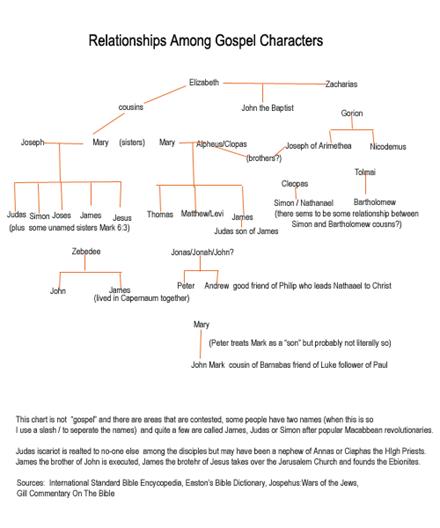
Jesus mother Mary had a “sister” also called Mary, who was married to someone known both as Clopas (John 19;25) and Alpheus (above) who is the father of James the Lesser and Matthew. That makes James the Lesser and Matthew both cousins of Jesus. Thomas seems to be a twin of Matthew, which would also make him a son of Alpheus and a cousin of Jesus as Matthew, Thomas and James are often mentioned together that would make sense. James and John were “sons of Zebedee” who was from Capernaum, as also was Peter and later Jesus made this city His home. Judas “the brother of James” is probably better “Judas son of James” – being James (Zebedee’s) son. Andrew and Peter were also brothers (Matthew 4:18, 10:2) and Philip seems to have been Andrew’s good friend as they always seem to be doing things together. Nathanael is led to Christ by Philip.
As this gets very confusing very quickly I have attached a diagram with the relationships between various gospel characters to this email. The apostles were relatives, friends and neighbors of Jesus. Gradually Jesus brothers meshed in with this group and James the brother of Jesus became the head of the Jerusalem Church and the author of the epistle of James. James apparently was quite a strict ascetic and possibly a vegetarian. The angels not the “band of brothers” theme when they call them “men of Galilee” as they were all from the same region.
“The women” are probably their wives and sisters, Mary the mother of Jesus may now have become the gentle matriarch of this band of brothers, cousins and friends of Jesus.
Miracle of miracles – all these relatives, friends and families were “of one accord”. They had been through a great deal and were now united in prayer and supplication.
The upper room may have belonged to John the apostle, some historians have it as the same upper room in which the Passover was eaten, yet others see it as the room of Mary, the mother of John Mark and friend of Peter, where many church meetings were held in Acts. Wherever the room was it was about to have two historic events occur – the selection of an apostle and the arrival of the Holy Ghost in power.
A “Sabbath days walk” was about two thousand cubits or just under a mile. This is the most you are supposed to walk on a day of rest. In ancient times people could easily walk 20 miles in a day – one mile was a very short walk indeed! A twenty minute walk back to the Upper Room, time enough to discuss the goings on. Walking keeps the blood moving and helps the brain to think, much of the great conversations in Scripture are had while walking along with friends. This was also the style of the peripatetic philosophers of the day and I think of Plato.
Back to the life of the core group of the early church – “these all were continuing with one accord in prayer and supplication”. The core group of any church or spiritual organization has to be able to demonstrate continual spiritual unity in prayer and supplication. It is as we pray together that we stay together and our meetings should be soaked in prayer. The natural sibling rivalries and squabbles of the disciples were ironed out in intercession. The group is formed, and the philosophy and direction of the new movement is burned into the souls of those involved.
Jesus chose people who could be one. People of like temperament, from the same locality, often related to each other, with strong natural and spiritual ties who had been with Him for three years and suffered together with Him. Unity was the theme of His high priestly prayer in John 17, and unity was behind His choice of who He selected to lead His movement. Today it would look like nepotism to have so many relatives and friends and neighbors leading a movement, indeed it would be illegal to have so many relatives on a non-profit board! But this movement was going to suffer persecution - and they needed to be able to rely on each other from “the get go”. We need to build both spiritual and natural unity into our teams. Teams that are too diverse can crack under pressure. Unity is a key component in spiritual power and we need to consciously plan it into our organizations (without indulging in undue favoritism)
Acts 1:15-26 Judas Is Replaced
Acts 1:15-26 MKJV And in those days Peter stood up in the midst of the disciples and said, (the number of names together was about a hundred and twenty,) (16) Men, brothers, this Scripture must have been fulfilled, which the Holy Spirit by the mouth of David spoke before concerning Judas, who became guide to those who seized Jesus. (17) For he was numbered with us and had obtained part of this ministry. (18) Indeed, then, this one purchased a field with the reward of unrighteousness. And falling headlong, he burst apart in the middle, and all his bowels gushed out. (19) And it was known to all the dwellers at Jerusalem, so much so that that field is called in their own dialect, Akeldama, that is to say, Field of Blood. (20) For it is written in the Book of Psalms, "Let his estate become forsaken, and he not be living in it." And, "Let another take his overseership." (21) Therefore, it is right that one of these men who have companied with us all the time that the Lord Jesus came in and went out among us, (22) beginning from the baptism of John to that same day that He was taken up from us, to become a witness with us of His resurrection. (23) And they appointed two, Joseph called Barsabas, who was surnamed Justus, and Matthias. (24) And they prayed and said, You, Lord, knower of all hearts, show which one You chose from these two, (25) to take the share of this ministry and apostleship from which Judas fell, to go to his own place. (26) And they gave forth their lots. And the lot fell upon Matthias. And he was numbered with the eleven apostles.
There were 120 “names” in the Upper Room, a small to middle sized church, and it changed the world because a) it had high quality leadership b) the congregation was united in prayer and supplication and c) because the Holy Spirit fell upon it in power.
No church is so small that it cannot be greatly used of God. The Haystack Prayer Meeting that began the Great Awakening was just four young men, small groups in prayer can change the world.
Peter recited the doom of Judas and the need for a replacement. This simple act shows that Peter was seeing Jesus in the Old Testament and applying the Scriptures to the current situation. This is something Peter does quite a few times, quoting both OT scriptures and the well-known sayings of Jesus at critical points in the life of the early Church. Acts 2:14-40, 3:12-26, 4:8-12, 5:29-32, 10:34-43, 11:4-17, 15:7-11
Scripture should be the basis of ALL church actions. Too many assemblies are organized around Robert’s Rules of Order or various forms of church constitution. There is enough in Scripture to guide us – especially when an anointed Christian leader applies it to our current situations.
Peter looked at the gap in the ranks, then at the appropriate Psalm and knew what to do. The gap must be filled with someone who was of their group right from the start and who had seen the resurrected Christ. Some commentators suggest that Peter was hasty and should have waited and that God had Paul in mind for Judas’s place. Yet even if Peter had waited to fill the gap the converted Paul could not have filled the twelfth spot, as he had not been with the band of brothers since “the baptism of John”.
J.B. Lightfoot maintained that there were “no more apostles” on the basis of these verses - because an apostle must be someone who has seen the risen Jesus. However on one hand Timothy, Titus, and Apollos are clearly apostles and since they lived outside Jerusalem probably never saw the risen Christ. And on the other hand “at least 500” saw Christ after the resurrection (1 Corinthians 15:1-4) – but few of them were named as apostles! Thus Peter was not setting forth qualifications for being an apostle but rather the qualifications for someone to replace Judas among the Twelve. The argument about modern apostleship is too long and complex for this bible study but you can read an article on the topic at: http://www.aibi.ph/aibi/apostle.htm
Matthias is selected by lot – the first and last time this procedure is used in the New Testament and it occurs before Pentecost. The use of the lot was neither gambling nor voting, rather it was a polite way to break a deadlocked decision, exactly equivalent to tossing a coin to decide who will bat first in a game of cricket. The word for lot is “klerous” which is also used for dice and implies chance in the outcome. Klerous is never used to imply a vote or show of hands. By the way, I have failed to find any place where majority voting is ever employed as a godly decision-making tool in the Bible, even though it was known in Greek culture, possibly because of the politicking and contention it is apt to arouse.
After Pentecost the personal voice of the Holy Spirit is the main source of guidance (e.g Acts 13:2, 21:11). The choice was down to two, and rather than have a possibly divisive argument over personal qualities they “tossed a coin”. Prior to the use of the lot there were qualifications laid out, and considerable discussion. The use of the lot might be justified if there were two equal candidates for a senior pastor position and a deadlock had been reached. However, generally speaking, prayer, fasting, examination of the Scriptures and listening for the voice of the Holy Spirit should be the preferred methods of ecclesiastical decision-making.
“And the lot fell upon Matthias. And he was numbered with the eleven apostles.” Very little is known about Matthias and this has led to many early heretical gospels and sects using his name in vain. We need to be very careful when obscure bible characters are used to back up theological positions.

Acts 2:1-4 Pentecost Arrives
Acts 2:1-4 MKJV And in the fulfilling of the day of Pentecost, they were all with one accord in one place. (2) And suddenly a sound came out of the heaven as borne along by the rushing of a mighty wind, and it filled all the house where they were sitting. (3) And tongues as of fire appeared to them, being distributed; and it sat upon each of them. (4) And they were all filled of the Holy Spirit, and began to speak in other languages, as the Spirit gave them utterance.
Pentecost is a Greek word signifying the 50th part of a thing, or the 50th in order and was a Jewish feast held fifty days after the Passover. It was also known as the “Feast of Weeks” or the Feast of Harvest”. (Exodus34:22; Numbers 28:26; Deuteronomy 16:10, Leviticus 23:17, Leviticus 23:20; Numbers 28:27-31.) The festive season from Passover to Pentecost was a bit like Chinese New Year or Thanksgiving to Christmas/New Year. Everyone went home for it and Jews from all over the Roman Empire were gathered in Jerusalem.
“And in the fulfilling of the day of Pentecost” – the fifty day Pentecost feast season was at its climax. It was also the prophetic fulfillment –as all the traditional Jewish Feasts are fulfilled in Christ Jesus.
“they were all with one accord in one place.” There is great power in prayerful unity gathered in one place. In 1980 I attended a large Christian gathering called Expo 80 in Brisbane Australia and as thousands of Christians from various denominations prayed together I had a vision of the heavens opened and a demonic attack against the city, in the form of a black cloud, being driven out.
When pastors of many denominations pray together and repent together revival often follows. Books have been written on this principle by people such as George Otis Jr. and Ed Silvoso and Stuart Robinson’s wonderful article Praying The Price of Revival is available at http://www.aibi.ph/prayer/payprice.htm
We cannot dwell in division and disunity and then expect revival. The church has to be a place of prayer for all nations, and a habitation of angels and the Holy Spirit - spiritual beings who are easily offended by carnality, worldliness and strife.
God comes into the midst of sincere obedient believers who are united in prayer and tender of heart and who expect Him to turn up in their midst. We must expect God and wait on God and cry out to Him believing that He will send revival.
The revival came both as a inward personal work and an outer visible manifestation. Anyone with ears to hear and eyes to see could observe the mighty rushing wind and the tongues of fire. This was not just a private mystical moment that you could later say “did that really happen”, it was tangible, physical, observable evidence of the Presence of God.
The actions of God can be made visible. Yesterday our two kittens, a male Mozzie and a female Crystal had their “little operations” and were rather sore and sorry. Crystal, the female cat was avoiding both us and Mozzie the male cat and was walking along the foot of the bed looking quite miserable as my wife and I went to sleep. So I raised my left hand towards Crystal and prayed “the love of Jesus upon you” for about two minutes. Crystal stopped and turned, faced my hand then walked straight up to me, curled up on the bed and went contentedly to sleep. My wife watched this and said that “a cylinder of smoke” went out of my hand towards the cat while I was praying but was not there after I stopped praying. The smoke Minda saw was a visible manifestation of the spiritual power of praying the love of Jesus. It is a small but significant thing and may help you understand the tongues of fire on the day of Pentecost.
“And tongues as of fire appeared to them, being distributed; and it sat upon each of them. And they were all filled of the Holy Spirit, and began to speak in other languages, as the Spirit gave them utterance.” It was a universal experience, each of them got a tongue of fire upon their head, and all were filled with the Holy Spirit, and all began to speak in tongues as the Spirit gave them utterance. True revival comes to all who are in fellowship just as the Spirit fell on all the seventy-two elders appointed by Moses so it fell on all the 120 in the Upper Room.
The Holy Spirit did not fall upon the High Priests or the scribes or the Pharisees or the so-called spiritual experts. The Holy Spirit is not confined to the lines of ecclesiastical rank or procedure. Rather the Holy Spirit falls upon the meek and humble and faithful saints who seek the Lord.
Finally the Holy Spirit directed the entire experience “as the Spirit gave them utterance”. We do not have to limit the Holy Spirit or tell Him how to behave; He is God, He is holy and He is extremely intelligent and He tells us how to behave! The Holy Spirit is not a force that must be channeled, rather He is God, and He gives utterance according to His will and His order. You can trust God the Holy Spirit to wisely direct your ministry and to order your worship, just as you would (I hope) trust Jesus to do so if he were in your midst.
Acts 2:4-13 The Gift of Tongues
Acts 2:4-13 MKJV And they were all filled of the Holy Spirit, and began to speak in other languages, as the Spirit gave them utterance. (5) And dwelling at Jerusalem there were Jews, devout men out of every nation under heaven. (6) But this sound occurring, the multitude came together and were confounded, because they each heard them speaking in his own dialect. (7) And they were all amazed and marveled, saying to one another, Behold, are not these who speak all Galileans? (8) And how do we each hear in our own dialect in which we were born? (9) Parthians, and Medes, and Elamites, and the dwellers in Mesopotamia, and in Judea, and Cappadocia, in Pontus, and Asia, (10) Phrygia, and Pamphylia, in Egypt, and in the parts of Libya around Cyrene, and strangers of Rome, Jews and proselytes, (11) Cretans and Arabians, we hear them speaking the great things of God in our own languages. (12) And they were all amazed, and were in doubt, saying to one another, What does this mean? (13) But others mocking said, These men are full of sweet wine.
There are some that say that Pentecost was a miracle of hearing, because each heard them speaking in his or her on dialect. However verse 4 clearly says: “and began to speak in other languages, as the Spirit gave them utterance.” The disciples were actually speaking “other languages” under the influence of the Holy Spirit.
God can give us supernatural linguistic ability in the tongues of men and of angels. Tongues is a wisdom gift – it is knowledge you did not have before – knowledge of Elamite or Parthian or whatever – and godly wisdom is the biblical sign of the presence of the Holy Spirit.
Two incidents from my early Christian life and ministry may illustrate this. The first was when I was at bible college and was in a small group with a Korean brother who burst into passionate prayer in his own language and I suddenly understood every word that he said – even though I do not know a word of Korean.
The second incident was in late 1986 when I spent a couple of months teaching Isaiah at the Gogodala Christian Training Center in Mapodo in the remote Western Province of Papua New Guinea. In just three weeks I picked up the complex Gogodala language enough to produce my lecture notes in it. It seemed to almost “beam into” me. I became temporarily fluent in the language and then promptly forgot it and today all I can say is “Nagala” which means hello.
God the Creator has access to the language centers of our brain – which He demonstrated at the Tower of Babel in Genesis chapter 11. God can confuse our languages on one hand or help us to understand them and speak them on the other.
The missionary task of the church requires linguistic ability, which God can give us by the empowering work of the Holy Spirit. Tongues is not just a nice worship experience, it is also tool for spreading the gospel.
There are also worship tongues and prayer tongues for communicating with the unseen realms – see 1 Corinthians 14. My own prayer language sounds like a Melanesian language but I have never identified it as a particular language group. I only use it for private worship and for intercession.
As I said before tongues is a wisdom gift and at Pentecost the wisdom was displayed in two ways: a) knowledge of foreign languages and b) knowledge of the glory of God and how to proclaim it. Tongues is not spiritual folly and it should not be seen as foolish (e.g. those who said “they are full of sweet wine”).
True tongues are wise and indicate that we are receiving knowledge from God about Himself and about the larger world (in this case a language of the world). Thus the tongues-speaker should demonstrate godly wisdom. The spiritual fruit of godly wisdom was the hallmark of selection of the first deacons in Acts 6 and a mark of people who were recognized as possessing ‘a spirit of the gods’ such as Joseph, Solomon and Daniel. Godly wisdom is also part and parcel of what we intuitively call “sainthood”.
All spiritual gifts should be used in love and lead to an integrated personality full of wisdom and truth. In a few cases tongues can be demonic and disturbing. Tongues that do not glorify God or produce wiser saints need to be tested. God even tells us to test the spirits. (1 John 4:1-4)
Finally tongues should not be used divisively. As an inter-denominational missionary I often do not disclose the fact that I speak in tongues, and I only use my gift in circles where it is readily accepted and will not cause confusion or discord. There is nothing wrong in restraining a spiritual gift out of love or out of concern for the body of Christ. This is still a delicate thing in many circles and I would not injure the faith of any.
Acts 2:14-21 This Is That
Acts 2:14-21 MKJV But Peter, standing up with the Eleven, lifted up his voice and said to them, Men, Jews, and all who dwell at Jerusalem, let this be known to you, and listen to my words. (15) For these are not drunk as you suppose, for it is the third hour of the day. (16) But this is that which was spoken by the prophet Joel: (17) "And it shall be in the last days, says God, I will pour out of My Spirit upon all flesh. And your sons and your daughters shall prophesy, and your young men shall see visions, and your old men shall dream dreams. (18) And in those days I will pour out My Spirit upon My slaves and My slave women, and they shall prophesy. (19) And I will give wonders in the heaven above, and miracles on the earth below, blood and fire and vapor of smoke. (20) The sun shall be turned into darkness and the moon into blood, before that great and glorious Day of the Lord. (21) And it shall be that everyone who shall call upon the name of the Lord shall be saved."
No spiritual experience is self-interpreting. Experience must always be interpreted by Scripture –and Scripture by experience. (If your bible interpretation ends up with the world being flat then you need to check your Scriptural interpretation against reality.)
Christianity is neither all mysticism nor all pragmatism. I like to say that sane faith is mystical pragmatism and combines direct experience of God with hard-nosed reality testing. Pentecost seems all mysticism, all tongues and fire and prophecy but Peter does not stand up and say that he heard voices – rather he speaks from Scripture.
Peter first corrects the wrong interpretation by referring to the obvious facts: “For these are not drunk as you suppose, for it is the third hour of the day.” The probability of mass drunkenness at 9am is very low. Maybe there is another explanation / interpretation. Peter then gives it to them: But this is that which was spoken by the prophet Joel: "And it shall be in the last days, says God, I will pour out of My Spirit upon all flesh.”
“This is that.” This experience is that Scripture, that prophecy, that moment in history. Ninety-nine percent of the time people make such identifications they are wrong. Bill Gates is the Anti-Christ, Jesus will return in 2000, the Millennium Bug is the beginning of the Tribulation. The Jehovah Witnesses, I believe, have finally given up on end-times date setting. Go to any psych ward and you will find people who believe they are Jesus or Satan or one of the two prophets of Revelation 11.
But Peter was correct! This was the prophecy come true; this was Joel’s outpouring of the Holy Spirit upon “all flesh” – old men, young men, women and male and female servants. This was the spiritual gateway to a new era of Holy Spirit power.
So sometimes we can get it right. Why then do we most often get it wrong? There are two main reasons that I find. The first is what I call “unverified cut-and-paste theology and philosophy”. This is where the only reference point is a holy book or books and quotes from these books are taken out “cut-and-paste” fashion and assembled into theories about reality without ever going out and checking on reality to see if things are actually so. People who conclude that everyone MUST be healed by prayer are in such a camp, as are cultists and flat-earthers. The prosperity gospel is also in this category because if it were ever tested against reality it would be found to be most utterly wrong. But it sounds good and it cuts-and-pastes quite well.
The second reason is almost the opposite it involves almost cutting and pasting reality to fit Scripture. Instead of saying the world must fit the Bible like the flat-earthers do, they say the Bible must fit our world and our concerns. It takes our current reality so seriously that it assumes that the Bible must be speaking about Iraq or Russia or Microsoft or whatever and that our nation e.g. the USA and Britain must be in there somewhere with a central role. We assume that the Bible is about us and that if we use the Bible Code and find our name in the equidistant letter spacings we will have discovered a great secret.
The first error constricts reality (to that of the texts) and the second error constricts God’s actions (to our concerns). Perhaps this is because on one hand we want to have reality tidily explained by our theory and on the other we want to also be the center of reality and of God’s actions. But God will remain God and He will leave us puzzled and bewildered and humbled.
How then can be saved from error when like Peter we say: “this is not X, this is that – it is Y”.
Look at reality: Has the Holy Spirit actually fallen on a large number of people? (which had rarely, if ever, happened since Moses’ day).
Look at the Scripture: Is there a Scripture that predicts or explains the Holy Spirit falling on a large number of people?
Look at the spiritual timing: Does the Scripture fit in with these days and times “in the last days.”?
Look at the fruits of the interpretation: 3000 people saved in one day and a vibrant spiritual community established.
This last is important – if the interpretation produces rogues and shysters and cults and quacks – then very probably it is not from God.
Acts 2:16-18 A Prophetic Church
Acts 2:16-18 MKJV But this is that which was spoken by the prophet Joel: (17) "And it shall be in the last days, says God, I will pour out of My Spirit upon all flesh. And your sons and your daughters shall prophesy, and your young men shall see visions, and your old men shall dream dreams. (18) And in those days I will pour out My Spirit upon My slaves and My slave women, and they shall prophesy.
The Holy Spirit is not just a fuel additive; rather the Holy Spirit is essential for the proper ethical development of the conscience of the Church into a godly prophetic community.
Pentecost is a fulfillment of the prophesy of Joel and Old Testament prophets were “enforcers of the Covenant” to borrow a term from Gordon Fee. So when Joel says “And your sons and your daughters shall prophesy” he was not merely stating that “they will have ecstatic experiences”, rather he is also saying that “they will become morally insightful and have well developed consciences that accurately hear and understand the will of God.”
When people claim to be prophets, yet are morally willful and spiritually insensate, they are false prophets. The testimony of Jesus is the spirit of prophesy (Revelation 19:10) and a true prophet will walk in the teachings and testimony of Jesus and thus “sound like the Sermon On The Mount”.
That said prophecy is not to be lightly dismissed, the New Testament church is clearly prophetic right from the start and continues to be so even in some of the worst churches such as Corinth. For a full article on the nature of NT prophecy go to: http://www.aibi.ph/aibi/prophecy.htm
Lets go back to the statement in Revelation 19:10 “for the testimony of Jesus is the spirit of prophecy.” Thus witnessing to Jesus and being a living testimony to Him is central to New Testament prophecy. This testimony is to have profound moral impact:
1 Corinthians 14:24-25 MKJV (24) But if all prophesy, and some unbeliever or one not instructed comes, he is convicted by all, he is judged by all. (25) And so the secrets of his heart become revealed. And so, falling down on his face, he will worship God and report that God is truly among you.
Thus the result of NT prophecy is to be a powerful testimony to Christ leading to a repentant world and the growth of the Church. Which is why Paul was so keen for Christians to have the gift of prophecy (see 1 Corinthians 14). Thus the focus of prophecy in the average Christian church should not be Iraq, the Middle East or the USA – but rather Christ, the human heart and repentance and faith.
Now prophecy is not the same as preaching, the Pharisees preached, but they did not prophesy. The prophetic gift flows from directly hearing the voice of the Holy Spirit and in speaking His Words with His timing. (see 1 Corinthians 2:9-16) It is not just expounding knowledge, it is speaking from God and with words given by God.
1 Corinthians 2:13 MKJV (13) These things we also speak, not in words which man's wisdom teaches, but which the Holy Spirit teaches, comparing spiritual things with spiritual.
The phrase “but which the Holy Spirit teaches” implies that there is a learning process and as anyone who has sincerely tried to hear from God will tell you, that learning process takes many years for most people. We are in the process of redemption and our minds and consciences are in the process of renewal and we “see through a glass darkly” and know imperfectly (1 Corinthians 13:12). Thus while Christians can claim to have heard from the Holy Spirit they cannot claim perfect knowledge. The days of writing Scripture are over.
As our conscience is renewed we begin to hear from God more clearly and can prophecy with greater power, accuracy and anointing. The Spirit-filled conscience is essential to the true understanding of Scripture (which will otherwise appear as folly) and is the guide that allows us to “walk in the Spirit” and be “led by the Spirit”. (1 Corinthians 2:14,15; Galatians 5:16-18,25)
Joel’s prophecy indicates that all Christians will be able to receive wisdom from God without any need for a human mediator, they shall hear directly from God through prophesy, dreams and visions: “I will pour out of My Spirit upon all flesh. And your sons and your daughters shall prophesy, and your young men shall see visions, and your old men shall dream dreams. (18) And in those days I will pour out My Spirit upon My slaves and My slave women, and they shall prophesy.”
The apostle John also says that the Holy Spirit enables Christians to receive wisdom and knowledge directly without a human teacher:
1 John 2:20 MKJV But you have an anointing from the Holy One, and you know all things.
1 John 2:27 MKJV But the anointing which you received from Him abides in you, and you do not need anyone to teach you. But as His anointing teaches you concerning all things, and is true and no lie, and as He has taught you, abide in Him.
Thus the gift of the Holy Spirit should enable believers to hear from God and receive the testimony of Jesus and live in repentance and faith, walking in the Spirit and being led by the Spirit via His deep anointing in our renewed and redeemed minds so that we “have the mind of Christ” and understand the things that He has prepared for those that believe. (1 Corinthians 2:9-16)
Coming back to my opening statement: “The Holy Spirit is not just a fuel additive” – we have to go beyond the view that the Holy Spirit is desirable because He will enable us to have “an international ministry” or some such thing. The Holy Spirit has three primary tasks – to love us into maturity (Romans 5:5, Ephesians 3:14-21); to reveal godly wisdom to us (1 Corinthians 2:9-16), and to empower us to be witnesses to Jesus (Acts 1:8) and in the end the Holy Spirit should build us into wise, loving empowered communities of grace who hear directly from God and have Christ-like consciences.
Acts 2:19-21 An Age Of Wonders And Salvation
Acts 2:19-21 MKJV And I will give wonders in the heaven above, and miracles on the earth below, blood and fire and vapor of smoke. (20) The sun shall be turned into darkness and the moon into blood, before that great and glorious Day of the Lord. (21) And it shall be that everyone who shall call upon the name of the Lord shall be saved."
Peter announces the Church Age, which would begin in prophecy and end with the moon becoming as blood. In between there would be: wonders in the heaven above, and miracles on the earth below, blood and fire and vapor of smoke.
The Church Age was meant to be extraordinary, an age of salvation and miracles, but we have settled for “just ordinary”. There is little that happens in churches today that did not also happen in temples and synagogues before the advent of Jesus, before the power of the cross and before the new life of the resurrection and the demon-breaking power of the ascension of Jesus Christ.
Surely Jesus did not come to build more synagogues? Did Jesus die just so we could have more sermons and lectures and ethical harangues and rules and nice songs and heart-warming rabbinic stories? Is the new life just another moral change, like going to Alcoholics Anonymous?
Does not it sound more plausible that God sent His Son to bring miracles and signs and wonders and an age full of Spirit and power and glory and salvation?
If what we have now is what God intended then Jesus did not need to die on the cross. The synagogues and temples would have made people just as good and just as happy as the average Christian church does today. Perhaps more so.
Jesus was not like Buddha. Jesus was much more spectacular. He did miracles all the time. He introduced a Kingdom of God in which spiritual power was freely available to all who asked for it and the apostles could, years later, write down promises about moving mountains with perfect truthfulness and equanimity.
Part of the reason I am doing this series in Acts is to arouse a burning thirst for a better way of being Christian. We have lost the supernatural life of Christ in our midst. What will it take to get it back?
Miracles seem to have been common in the early church – even in the most backward of churches such as the Galatians: Galatians 3:2-5 MKJV This only I would learn from you: Did you receive the Spirit by works of the law, or by hearing of faith? (3) Are you so foolish? Having begun in the Spirit, do you now perfect yourself in the flesh? (4) Did you suffer so many things in vain, if indeed it is even in vain? (5) Then He supplying the Spirit to you and working powerful works in you, is it by works of the law, or by hearing of faith?
We have grieved, quenched and injured the Holy Spirit in our midst, we have exalted man and diminished Christ, we have loved the world and spurned the cross. We have let our disillusionment and our doubts overwhelm our faith in God and we have lived as selfish individuals instead of in loving Spirit-filled communities.
The fire and thunder are gone and Musak and elevator music fill quiet respectable sanctuaries.
No-one would bother to persecute the average American or Australian or English church. It threatens nothing, it does nothing, it accomplishes next to nothing. Apparently it costs $300,000 to add a single baptized believer to a church in the USA. Enormous effort, zero result. In the last few years 5 million Christians in the USA have gone from “active” to nominal Christian or unbeliever status.
Where is the power, the sacrifice, the zeal, the faith?
We have turned Christianity into another “seven steps to personal success”. We have focused it on ourselves and on our desires. We have fed the flesh and starved the Spirit.
Where is our inheritance in God, and in His power? Where is the fire of Pentecost? Where is the promise of Joel? “And I will give wonders in the heaven above, and miracles on the earth below, blood and fire and vapor of smoke. “
Acts 2:21 All Who Call On The Lord Are Saved
Acts 2:21 MKJV And it shall be that everyone who shall call upon the name of the Lord shall be saved."
This promise of Joel about abundant salvation was not an accidental statement of Peter’s and was no isolated text, in fact it became a cornerstone of Paul’s basic gospel outlined in Romans 10:
Romans 10:9-13 MKJV Because if you confess the Lord Jesus, and believe in your heart that God has raised Him from the dead, you shall be saved. (10) For with the heart one believes unto righteousness, and with the mouth one confesses unto salvation. (11) For the Scripture says, "Everyone believing on Him shall not be put to shame." (12) For there is no difference both of Jew and of Greek, for the same Lord over all is rich to all who call on Him. (13) For everyone, "whoever shall call on the name of the Lord will be saved."
This verse tells us that salvation is abundant, easy, free and instantaneous. This is confirmed a few verses later on where it says: Acts 2:41 MKJV Then those who gladly received his word were baptized. And the same day there were added about three thousand souls.
Thus Christian salvation is not some long arduous costly penance in sackcloth and ashes. Neither does Christian salvation involve saying hundreds of Masses or thousands of rosaries and prayers to dead saints.
Salvation in the Day of Pentecost involved: repenting, believing/gladly receiving his word, calling on Jesus and being baptized in His Name and receiving the Holy Spirit. This all happened without any formality, without any sacrifices, or any money being exchanged, or any priestly rituals by men in long robes. It was free, it was abundant, it was instantaneous, it was powerful and it was informal lay preaching by a Spirit-filled fisherman.
Christian salvation does not involve an eight-fold path or a long course in theology. Christian salvation is as simple as: “And it shall be that everyone who shall call upon the name of the Lord shall be saved."
Salvation is very simple: I have a cousin who was saved at eighteen months when he kept putting a gospel tract in the washing machine (a wordless book with black, red, and white pictures of the heart) and when his mother (my aunt is a child evangelist) asked Jeremy why he kept doing this he replied “I want a clean heart”. He called on the name of the Lord and was saved! I have seen people who could not read saved, and people with no education saved, and tribal people in remote areas of the world saved.
In Muslim lands new believers cannot ever attend a church – but they are still saved. Some of them have never seen a bible but have met Christ in dreams and visions and perhaps through preaching – and yet they have called on Him and been saved.
Such a person knows little about the historical Jesus and nothing about the Trinity. Such a person is saved because their human spirit calls out to God and desires relationship, and asks forgiveness and wants to receive God’s love through Christ, in the name of Jesus.
Salvation does not require money, knowledge or rituals. It does require repentance and faith and a calling on the powerful name of Jesus and a reception of the Holy Spirit.
The name of Jesus has real power. You can test the incredible power of the name of Jesus by using it to rebuke a demon – the demon obeys. The name of Jesus has power and authority and brings healing and salvation and deliverance. The name of Jesus is the doorway to the presence and power and healing and salvation and love of God. John 10:9 MKJV I am the door. If anyone enters in by Me, he shall be saved and shall go in and out and find pasture.
The abundant, free, easy and instantaneous salvation of Acts has been made out to be narrow, costly, hard and gradual in many quarters. It is not in the interest of ecclesiastical power to have salvation too freely available! But this is what Jesus says about the nature of salvation: Matthew 11:28-30 MKJV Come to Me all you who labor and are heavy laden, and I will give you rest. (29) Take My yoke on you and learn of Me, for I am meek and lowly in heart, and you shall find rest to your souls. (30) For My yoke is easy, and My burden is light.
The apostle John confirms this lack of complexity: 1 John 5:3 MKJV For this is the love of God, that we keep His commandments, and His commandments are not burdensome.
People are saved simply by calling on the name of Jesus – and not by adhering to any ecclesiastical system. There is a very common notion that salvation comes from joining a spiritual organization, then agreeing to its tenets, then conforming to its practices and receiving the approval of the priest or guru or senior pastor, which may or may not be dependent on paying a tithe. The person receives spiritual approval and emotional assurance of heaven in return for what the organization deems to be “good behaviour”. This is a travesty of the gospel!
Salvation is not the same as approval by clergy. Salvation is approval by God because you have called on the name of His beloved Son who died for you to reconcile you to God.
Salvation is abundant, easy, free and instantaneous and is offered through believing the preaching of the gospel. Baptism is your way of saying that you have repented and believed and now wish to be immersed in God and have called on the name of Jesus into which you are baptized. And all the aspects of salvation – healing, deliverance, emotional restoration, breaking of habits, healing of memories and so forth are in the same mold – that is they are abundant, easy, free and instantaneous and are obtained by calling on the name of Jesus. You probably find that last sentence to be quite outrageous – you may have had a habit or an illness for years. You may have often “prayed about it” and it has not moved.
Try this: Call out earnestly and personally to Jesus as earnestly and personally as the blind men on the road to Jericho, then be still and silent and wait for Jesus to turn up, and command this habit/illness/problem to be gone in His name. I have often seen amazing things happen on the spot when this is done.
Acts 2:22-23 The Predetermined Plan And Foreknowledge of God
Acts 2:22-23 ISV "Fellow Israelites, listen to these words! Jesus from Nazareth was a man accredited to you by God through miracles, wonders, and signs that God performed through him among you, as you yourselves know. (23) This very man, after he was arrested according to the predetermined plan and foreknowledge of God, you crucified and killed by the hands of lawless men.
“Jesus of Nazareth” – that was His name among the people in Jerusalem, He was not yet known as Jesus the Christ. There is no hint of His deity in this passage, Jesus is “a man accredited to you by God”. Peter starts with what they can believe and leaves the deeper theological insights until after conversion.
Jesus was not accredited by the scribes or by the Temple authorities but by God and the method of His accreditation was not a diploma – but “miracles, wonders, and signs that God performed through him among you.”
The servant of God must first of all be accredited through the Spirit of God, without that ordination is meaningless. I have known an unconverted Baptist pastor. These are fairly rare but this man had such abilities and political skill that he sailed through the ordination process. But he was of course a disaster in the ministry. Human accreditation is fallible, some good folk are rejected and some terrible folk are ordained. The true accreditation is from God.
Now this accreditation is not just a sense of being called, or a warmed heart, or a desire for ministry. The accreditation is the demonstration of godly spiritual power and the ability to bless others through the Spirit. The accreditation of an evangelist is significant numbers of converts, of a pastor - clear spiritual growth, of a teacher - people learning and being discipled, of a healer - the raising up of the sick; and so forth. There must be results. Under normal circumstances a minister with no results is suspect. (This does not apply to new works in difficult places.)
“As you yourselves know” – Jesus accreditation by God was publicly observable, it was obvious. One look at Jesus was enough – his godliness was evident. And ours should be too. True saints are holy on sight, they glow.
“This very man, after he was arrested according to the predetermined plan and foreknowledge of God,” Now comes the difficult bit – can God plan a gross injustice? Can the murder of a man as innocent as Jesus be part of the predetermined plan of God?
Either answer presents significant problems. If you say “yes” God plans the murder of innocent people – you have a big problem. If you say “no” then the martyrs die outside of God’s plan. Was the cross an evil accident of chance or was it planned by God? If it was planned by God is He still a holy and moral God?
It helps if we see the whole picture. That not only the cross was planned by God, but also the resurrection, ascension and glorification of His beloved Son and His return in glory. In other words God had no malice towards Jesus. He was not acting brutally towards an innocent man – even though He allowed Jesus to suffer greatly.
We have to look at our life and sufferings as a whole, with glory in view.
2 Corinthians 4:16-18 ASV (16) Wherefore we faint not; but though our outward man is decaying, yet our inward man is renewed day by day. (17) For our light affliction, which is for the moment, worketh for us more and more exceedingly an eternal weight of glory; (18) while we look not at the things which are seen, but at the things which are not seen: for the things which are seen are temporal; but the things which are not seen are eternal.
Sufferings work glory. Thus by allowing Jesus to suffer, He allowed Jesus to come into a great weight of glory. At a human level it was an injustice but on a spiritual level it was an opportunity for great gain.
God is always trying to bless the righteous and sometimes trials are the greatest blessings of all (though I do not enjoy them and protest as much as anyone, if not more so). Therefore we rejoice…. (see Romans 5:1-5, 1 Peter 1:6-8 etc)
God weaves our lives into a rich tapestry and some threads are sorrows, but they are temporary and joy is always the final state of the Christian – and Jesus knew that because “for the joy set before Him, He endured the cross..”.
Hebrews 12:1-2 MKJV Therefore since we also are surrounded with so great a cloud of witnesses, let us lay aside every weight and the sin which so easily besets us, and let us run with patience the race that is set before us, (2) looking to Jesus the Author and Finisher of our faith, who for the joy that was set before Him endured the cross, despising the shame, and sat down at the right of the throne of God.
You may suffer a terrible wicked injustice in this life that scars you and tears your soul. It may be as demonic and hateful and cruel as the Cross. You may be delivered to be crucified and killed by the hands of lawless men. And yet it may well be part of God’s will for you. If it is, you will come into great glory as a result. This is not an abstract thing - researchers tell us that 150,000 Christians are martyred every year - and in the last days the Devil will make total war on us.
It is crazy to desire such a thing – even Jesus prayed that the cup would pass from Him. No sane person wants to suffer. But in the end we trust God and say “Not my will but Thine be done”. God’s plan is complex and has some very deep valleys and we may have to walk through them. Even in the midst of insane cruelty God is in charge and His plan is working for our ultimate good and our deepest joy. This is the “patient endurance of the saints”. (Revelation 14:12)
Acts 2:23-32 The Incorruptible Christ
Acts 2:23-32 MKJV this One given to you by the before-determined counsel and foreknowledge of God, you have taken and by lawless hands, crucifying Him, you put Him to death; (24) whom God raised up, having loosed the pains of death, because it was not possible that He should be held by it. (25) For David speaks concerning Him, "I foresaw the Lord always before me, because He is at my right hand, that I should not be moved. (26) Therefore my heart rejoiced and my tongue was glad; and also My flesh shall rest in hope, (27) because You will not leave My soul in Hades, nor will You allow Your holy One to see corruption. (28) You revealed to Me the ways of life. You will fill Me with joy with Your countenance." (29) Men, brothers, it is permitted to say to you with plainness as to the patriarch David, that he is both dead and buried, and his tomb is with us to this day. (30) Therefore being a prophet, and knowing that God had sworn with an oath to him that of the fruit of his loins, according to the flesh, He would raise up Christ to sit upon his throne, (31) seeing this beforehand, he spoke of the resurrection of Christ, that His soul was not left in Hades, nor would His flesh see corruption, (32) God raised up this Jesus, of which we all are witnesses.
Apparently the rabbis of New Testament times had great difficulty with this passage (Psalm 16) about David not seeing corruption and made up implausible explanations – such as David not being affected by insects during his life. Peter thus gets a high level of audience attention by referring to Psalm 16 and then explaining the inexplicable – by referring to Christ.
“That of the fruit of his loins, according to the flesh, He would raise up Christ to sit upon his throne.” Jesus was a descendant of David and as such was born in the city of Bethlehem, David’s hometown. On one hand Jesus was a lowly carpenter, on the other hand He is of the royal line. This is a bit like the recent discovery by some genealogical researchers that apparently the ‘true king of England’ is an Australian stock and station agent! (This takes too long to explain). Jesus was hidden royalty and the rightful heir to the throne of David.
“Men, brothers, it is permitted to say to you with plainness as to the patriarch David, that he is both dead and buried, and his tomb is with us to this day.” It was clear that David was dead and that his mausoleum as a feature of Jerusalem then, though it has now been lost. This refutes some liberal scholars who maintain that David and Solomon never existed. David’s tomb is also mentioned by Josephus and by a Rabbi Benjamin.
Peter’s main point is two fold – a) Jesus was holy and innocent b) This meant that death could not hold Him and so He had to rise from the dead. This applies to us also, because we are justified by the blood of Jesus Christ, we are innocent, and death will not be able to hold us, and we will also rise from the dead on the Last Day.
“of which we all are witnesses.” The whole 120 had seen Jesus after He rose from the dead – some individually and others presumably as part of the 500+ that Paul refers to in 1 Corinthians 15. The resurrection of Jesus was a visible and verifiable demonstration of God’s power and the fulfillment of Psalm 16.
“You will not leave My soul in Hades, nor will You allow Your holy One to see corruption.” Other than the resurrection, there is a general spiritual principle here – that Christians may “go down to Hades” for a while, but they always come out. God does not abandon us to the natural processes of decay and the consequences that flesh is heir to. We will rise from the dead, and we will also rise from the midst of calamity and misfortune.
Psalms 34:19 KJV Many are the afflictions of the righteous: but the LORD delivereth him out of them all.
“You
will fill Me with joy with Your countenance.” The final lot
of the Christian is always joy, whereas the final lot of the wicked is
torment
(Isaiah 66:24). We will see God face to face, know His love and
experience
great joy. Joy is a big part of the gospel and the result of its
proclamation.
The New Testament is full of rejoicing saints:
Acts
8:7-8 MKJV For out of those having unclean spirits, many came
out, crying with
loud voice. And many who had been paralyzed and lame were healed.
(8) And
there was great joy in that city.
Thus God leads us through Hades to a place of great joy in His Presence. If you have been a Christian long enough you will have experienced this in many “little things”. The problem at work resolved, the last minute financial provision, the anguish at exam time – and at the end the gladness. We keep coming back to a place of joy – because that is the natural resting place of the Christian soul.
According to one ancient historian David died on the feast of Pentecost back in His time, so there is no small coincidence in Peter preaching about David on this day nearly a thousand years later after David’s passing. The spiritual realm is vast and complex and tantalizing –as the glimpse during the Transfiguration when Jesus spoke with Elijah and Moses, indicating they were very much alive in the spiritual realm and were still potent spiritual beings.
In the spiritual realm innocence breaks the bonds of death, life triumphs and joy explodes.
Acts 2:32-36 The Exalted Christ
Acts 2:32-36 MKJV God raised up this Jesus, of which we all are witnesses. (33) Therefore being exalted to the right of God, and having received from the Father the promise of the Holy Spirit, He has poured out this which you now see and hear. (34) For David has not ascended into the heavens, but he says himself, "The LORD said to my Lord, Sit at My right hand (35) until I place Your enemies as a footstool to Your feet." (36) Therefore let all the house of Israel know assuredly that God made this same Jesus, whom you crucified, both Lord and Christ.
These five verses are absolutely packed with profound theological statements:
1. God has raised Jesus from the dead.
2. Jesus has been exalted to the right hand of God.
3. Jesus received the promise of the Holy Spirit from the Father.
4. Jesus poured out the Holy Spirit on the Day of Pentecost in visible and audible manifestations of grace.
5. Jesus has been made both Lord and Christ.
6. Jesus will be at God’s right hand in Heaven until all His enemies have been subdued under His feet.
7. The Jews had crucified Jesus, who was now their exalted Messiah.
Thus their response of “What then can we do to be saved?” was perfectly understandable. More on that tomorrow.
The point of today’s study is this – Jesus is not wearing a beard and sandals any more. He is the mighty Son of God, in Heaven, at the right hand of the Father and pours out the Holy Spirit on His Church.
Jesus is exalted:
Ephesians 1:20-23 MKJV which He worked in Christ in raising Him from the dead, and He seated Him at His right hand in the heavenlies, (21) far above all principality and authority and power and dominion, and every name being named, not only in this world, but also in the coming age. (22) And He has put all things under His feet and gave Him to be Head over all things to the church, (23) which is His body, the fullness of Him who fills all in all.
Given that Jesus is no longer walking around Galilee and preaching from fishing boats and on mountains – how do we relate to Him? We relate to Him in at least four ways:
a) As Lord – we receive and believe His teachings, obey His commandments and do His work.
b) As Christ – as the anointed one, out who pours out the Holy Spirit, and performs healings and miracles in the midst of His Church.
c) As High Priest – who has passed through the heavenlies and understands our weakness and gives grace and help in time of need. (Hebrews 4:12-16)
d) As Son Of God – as deity, as God, as part of the Trinity, to be worshipped and adored and who will return in power and glory.
What are some of the things that Jesus is doing at the moment?
- He is upholding all things by the word of His power. (Hebrews 1:1-3)
- He is holding all things together. (Colossians 1:15-20)
- He is interceding for us. (Hebrews 7:25, Romans 8:34)
- He is pouring out the Spirit upon all flesh. (Acts 2:33) so that He might fill all things. (Ephesians 4:10)
- He is loving the saints into maturity. (Ephesians 3:14-21)
- He is sanctifying believers and preparing the Church to be His bride. (Ephesians 5:25-27)
Thus we need a clear vision of Jesus as He is now – as the risen exalted One who is both Lord and Christ. This is a bit more difficult to relate to than Jesus of Nazareth the carpenter, rabbi and prophet. Yet once grasped this vision can transform your life and the life of your church. Jesus is not a remote prophet dwelling in history a long time ago, He is a mighty ever-present and all powerful being who can dwell in your church and in your life.
Jesus wants to “fill all things” with Himself (Ephesians 4:10) and He started pouring out that infilling on the Day of Pentecost.
Because Jesus is no longer localized that pouring out can now occur at any place on the globe and at any time in history including right now.
(For more on this see Juan Carlos Ortiz’s excellent book “Living With Jesus Today. )
Acts 2:38-41 The Gift Of The Holy Spirit
Acts 2:37-41 LITV And hearing, they were stabbed in the heart, and said to Peter and the rest of the apostles, Men, brothers, What shall we do? (38) And Peter said to them, Repent and be baptized, each of you on the name of Jesus Christ to remission of sins. And you will receive the gift of the Holy Spirit. (39) For the promise is to you and to your children, and to all those afar off, as many as the Lord our God shall call. (40) And with many other words he earnestly testified and exhorted, saying, Be saved from this perverse generation. (41) Then truly the ones gladly welcoming His Word were baptized. And about three thousand souls were added that day.
The question is “Men, brothers what shall we do”? They were pricked to the heart by the fact they had crucified the Messiah. Peter’s reply is actually quite complex:
1. Repent.
2. Be baptized
3. Each one of you
4. On the name of Jesus Christ
5. For the remission of sins
6. And you shall receive the gift of the Holy Spirit
7. This is a promise to you and your children, near and far as many as the Lord shall call.
Firstly these verses definitely calls on all Christians ‘each one of you’ to be baptized, and if you have not been baptized, please do so immediately, in simple obedience to the word of God.
Secondly we clearly have a “salvation package” here that was all meant to happen in one day – repentance, faith, baptism and receiving the Holy Spirit. Verse 41 indicates that they were baptized that day - there was no delay. The Church of Christ and a few other denominations practice immediate baptism and I believe that is scriptural as we also see it in the case of the Ethiopian eunuch. (Acts 8:38)
The salvation package culminates in receiving the Holy Spirit – and in this case they would have expected receiving the Holy Spirit to include the gift of tongues and prophecy – because that is what the Holy Spirit “looked like” on this occasion. It is also what it looked like at the house of Cornelius and on a couple of other occasions. The Holy Spirit was received in such a way that was observable to an outsider – and this generally was both visible and audible. (see also Acts 8;17,18)
Receiving the Holy Spirit was a certainty – “each of you”…“you shall receive” …”this is a promise”. Thus this power was not just for special revivals now and then in Church history – it was for all believers from the moment of their new birth in Christ!
However receiving the Holy Spirit was not ‘automatic”, in Samaria it was delayed until the apostles got there and in Ephesus it only came after they had been baptized in the name of Jesus. For many people receiving the tangible real power of the Holy Spirit has been a second experience some time after conversion.
In my life there were a number of steps. Firstly I was definitely and clearly born again and received peace, understood the Scriptures and began to demonstrate the fruit of the Spirit. This was the Spirit in me. Then there was a deeper work of sanctification and empowerment after a revival sermon when I gained the power to witness and became a bold Christian, this was God’s Spirit upon me in power. It is after this that I knew would end up in Christian work.
Quite soon after this, through Campus Crusade I learned about how to have a daily infilling of the Holy Spirit and how to walk in the Spirit and have self-control and a sound Christian life. Then seven years later I spoke in tongues and twelve years after that I started finding myself healing people in Jesus’ name. Thus there has been a continual growth in my relationship with the Holy Spirit. I do not think that anyone else has to follow these same steps. However I do think that all Christians should seek the indwelling, infilling and empowering of the Holy Spirit.
The salvation package is not just a remission of sins package, though that is very important. It is also a receiving of the Holy Spirit.
Receiving the Holy Spirit is for everyone, as many as the Lord shall call, both far and near, indeed it is for “each one of you” – not just charismatics and Pentecostals. This is not a denominational thing – it is a God thing!
Do not be deterred (as I was for many years) by the irrational behavior of some who claim the Spirit. As I have repeatedly said, God is intelligent and expects us to behave intelligently also (if we are to be in His image)– and He gives us wisdom for this purpose. The Spirit is the Spirit of wisdom – not of folly, He is a Spirit of holy order, not of fleshly disorder.
Receiving the Holy Spirit in power can be different from His quiet inner dwelling after conversion. If you are a Christian, and Christ dwells in you, you have the Holy Spirit within you. However you may not yet have Him upon you in power for ministry and witness. You should seek this. It is not dangerous or crazy. God is good and only gives good gifts to His children:
Luke 11:9-13 CEV So I tell you to ask and you will receive, search and you will find, knock and the door will be opened for you. (10) Everyone who asks will receive, everyone who searches will find, and the door will be opened for everyone who knocks. (11) Which one of you fathers would give your hungry child a snake if the child asked for a fish? (12) Which one of you would give your child a scorpion if the child asked for an egg? (13) As bad as you are, you still know how to give good gifts to your children. But your heavenly Father is even more ready to give the Holy Spirit to anyone who asks.
Whatever your theology or your denomination I ask you to do what Jesus says in this passage – ask, search, knock. God wants you to have a deeper relationship with God the Holy Spirit and will pour His Spirit out if you ask Him to – it’s a promise for each of you!
Acts 2:42-47 The Spirit-Filled Community
Acts 2:42-47 MKJV And they were continuing steadfastly in the apostles' doctrine, and in fellowship and in the breaking of the loaves, and in prayers. (43) And fear came on every soul. And many wonders and miracles took place through the apostles. (44) And all who believed were together and had all things common. (45) And they sold their possessions and goods and distributed them to all, according as anyone had need. (46) And continuing with one accord in the temple, and breaking bread from house to house, they shared food with gladness and simplicity of heart, (47) praising God and having favor with all the people. And the Lord added to the church daily those who were being saved.
These verses are worth meditating on – they indicate what true revival looks like and give us a high calling to aim for in our fellowships.
These things are purely the products of a powerful move of God. No program can bring Christians to the point of gracious united communal living or of many miracles or of abundant joy or of favor among all the people.
Man simply cannot create these things – they are a product of the Holy Spirit, obedience and prayer.
The true transforming power in the Church is not the latest book or song or video (though these things have their place and are often blessed by God) but rather is God Himself.
We need to have God turn up. We need God to lead us into repentance and joy and faith and love and Christian community.
Many churches run very well without God turning up. They are nice and pleasant and function like the Jewish synagogues of old, with good teaching etc. But Jesus did not die in order to establish more synagogues.
Jesus died in order to create something that was not merely human. Jesus lived a supernatural life and He died so that we could have access to His supernatural life. The Church is “supposed to be” a Spirit-filled community of believers with supernatural powers living a life of amazing love in complete holiness.
For a moment that existed in Jerusalem; it has also existed among the Moravians in Herrenhut and at various other times and places of revival in Church history. Occasionally the Church does get it right. And all the times when the Church has got it right it has been in much prayer.
Revival should result in a self-less, harmless, generous community. While people remain individuals they become God-centered and not self-centered. The words I, me and mine will get used less often. Possessions are held lightly. Grace matters more than gold.
Sharing is a sign of maturing love. It is one of the main things we expect from our children as they mature. A child who will not share with his brothers or sisters is considered morally deficient. And so it should be among brothers and sisters in Christ:
Acts 2:44-46 And all who believed were together and had all things common. (45) And they sold their possessions and goods and distributed them to all, according as anyone had need. (46) And continuing with one accord in the temple, and breaking bread from house to house, they shared food with gladness and simplicity of heart,
Acts 4:32 And the multitude of those who believed were of one heart and one soul. And not one said that any of the things which he possessed was his own. But they had all things common.
Mature Christians are filled with love and generosity. They are not greedy, covetous or selfish. They have a highly developed sense of compassion, are sensitive to the needs of others, hearken to the voice of the Spirit and obey the clear and commanded will of God.
The Holy Spirit will never produce people who are greedy for more and more of the world’s goods for themselves.
Covetousness is idolatry (Ephesians 5:5, Colossians 3:5) and the only way out of idolatry is worship of the one true God. Which is why they “met in the Temple” and “were continuing steadfastly in the apostles' doctrine, and in fellowship and in the breaking of the loaves, and in prayers.” Spirit-filled worship will help people to be God-centered and not self-centered and thus assists them in fulfilling the commands of Christ.
“Praising God and having favor with all the people.” Praise lifted the community up to a higher plane of living. It made them observably better so that others gave them favor. They were positive folk, happy folk, grateful, joyful and worshipful. People liked them and liked being around them and were glad to join them. “And the Lord added to the church daily those who were being saved.”
Jesus gave us a new commandment “love one another”. This differs from “love they neighbor” because your neighbor could be quite distant. “Love one another” means communal love – form a community and love one another. That is what they did in Jerusalem – they lived together and loved one another in the power of the Holy Spirit.

Acts 3:1-10 Command Prayer
Acts 3:1-10 KJV Now Peter and John went up together into the temple at the hour of prayer, [being] the ninth [hour]. (2) And a certain man lame from his mother's womb was carried, whom they laid daily at the gate of the temple which is called Beautiful, to ask alms of them that entered into the temple; (3) Who seeing Peter and John about to go into the temple asked an alms. (4) And Peter, fastening his eyes upon him with John, said, Look on us. (5) And he gave heed unto them, expecting to receive something of them. (6) Then Peter said, Silver and gold have I none; but such as I have give I thee: In the name of Jesus Christ of Nazareth rise up and walk. (7) And he took him by the right hand, and lifted [him] up: and immediately his feet and ankle bones received strength. (8) And he leaping up stood, and walked, and entered with them into the temple, walking, and leaping, and praising God. (9) And all the people saw him walking and praising God: (10) And they knew that it was he which sat for alms at the Beautiful gate of the temple: and they were filled with wonder and amazement at that which had happened unto him.
There is much in this passage and we might spend a few days on it. We see how Christ overcomes “fate” and inherited effects, how weakness can be made strong, how those who beg can be made to rise up and walk – and so forth. But today I want to focus on just one often-neglected aspect – the way Peter and John performed the miracle and the kind of prayer that they used.
In the New Testament demons, death and diseases are all dealt with via “command prayers”. Jesus does not pray “please God cast out this demon” or “if it be Thy will please heal this man” rather He commands the demon to go or says “be healed” or “Lazarus come forth” and with the command comes the miracle. And since He gave this authority to His disciples (see Luke 10) they were able to issue similar commands and cast out demons, heal the sick and raise the dead.
We can understand this happening while Jesus was walking around, but we tend to doubt that it can happen after that. But it did! Here in Acts 3 is the archetypical New Testament miracle being performed by Peter and John – and it is also a command prayer: “In the name of Jesus Christ of Nazareth rise up and walk.”
In fact the vast majority (if not all) of the NT miracles are performed via command prayers.
Command prayers show we have faith in the fact that Christ has delegated His authority to us, and faith in His dwelling within us in power. It is certainly NOT faith in our own strength.
The lame man was not expecting to be healed or even asking to be healed. Initially he had no personal faith for healing at all. His faith seems to have operated in a moment, and combined with the power and authority of the command of the apostles, which was issued in the name of Jesus. The power of the name of Jesus becomes the issue in chapters 3 and 4 of Acts.
Acts 3:12-16 GNB When Peter saw the people, he said to them, "Fellow Israelites, why are you surprised at this, and why do you stare at us? Do you think that it was by means of our own power or godliness that we made this man walk… (16) It was the power of his name that gave strength to this lame man. What you see and know was done by faith in his name; it was faith in Jesus that has made him well, as you can all see.
Peter explicitly denies any special power or piety of his own. The healing ingredients here are: the command prayer, the power of the name of Jesus and having personal faith in the power of that Name.
Think of someone who is suddenly made a General by a King. Suppose that person issues no commands? Suppose he meekly begs the King to make the troops do this or that? Would this person remain a General for long? Certainly not! We have been seated with Christ in the heavenly realms and given power and authority in Jesus name over certain things and we are expected to exercise that authority.
For things that are in the “lower realms” beneath where we are placed in the Heavenly realms – we are to use commands. For demons, death and disease, we can issue orders in Jesus name. When it comes to high and holy spiritual matters such as the health of the Church then we must bow our knees before the Father in prayer and supplication. (Ephesians 3:14)
On a practical level, command prayers work and I saw no healing at all until I started using them. They are absolutely essential when dealing with the demonic.
Learning to pray command prayers is quite difficult and they may seem strange at first. They are probably best learned in a small group setting.
Mountain-moving faith involves commanding difficult situations:
Matthew 17:20 MKJV And Jesus said to them, Because of your unbelief. For truly I say to you, If you have faith like a grain of mustard seed, you shall SAY TO THIS MOUNTAIN, Move from here to there. And it shall move. And nothing shall be impossible to you.
With command prayer and mustard-seed faith in the power of the name of Jesus results will be obtained: “And it shall move. And nothing shall be impossible to you.”
Thus command prayer is part of the secret of the power of the apostolic age.
Acts 3:4-8 Strength From God
Acts 3:4-8 MKJV And fastening his eyes on him, Peter with John said, Look on us! (5) And he paid heed to them, expecting to receive something from them. (6) But Peter said, Silver and gold have I none, but what I have I give you. In the name of Jesus Christ of Nazareth, rise up and walk! (7) And taking him by the right hand, he lifted him up. And immediately his feet and ankle-bones received strength. (8) And leaping up, he stood and walked and entered with them into the temple, walking and leaping and praising God.
Yesterday we looked at command prayer as part of the way God heals people through the power of the name of Jesus. Today we will look at the process of receiving strength from God.
- The beggar wanted money but God gave strength and the means of production. God most often gives the power to make wealth not wealth itself. (Deuteronomy 8:18)
- Peter gave the beggar what he had – healing in the name of Jesus. God calls us to give “what is in our hand” – whether it be spiritual or temporal goods. (1 John 3:16-18)
- Peter acted “in the name of Jesus Christ of Nazareth” not in his own name or the name of an organization or denomination.
- Peter took the beggar by the right hand, and gave some initial “lift” and God did the rest. There was a connection between the beggar and God’s servants.
- There was an expectation of receiving good (verse 5) mingled with faith in Jesus name (verses 12-14 same chapter).
- The strength became immediately available and resulted in great joy and praise to God.
The strong and the weak both are part of the body of Christ, and the strong are expected to help the weak. Christianity is built on giving and receiving – and we are each strong (and weak) in different places. A poor man may heal a rich man, a teacher may instruct a mechanic in the Scriptures, the mechanic may fix the teacher’s car in return. We are thus all in the process of lovingly making each other stronger.
Strength from God generally arrives via another believer acting in the name of Jesus. I hope that Eternity Daily Bible Study brings strength to your lives. Your encouragements bring strength to my life – and so on and so forth.
In each of these exchanges there should be an expectant “receiver” and an empowered “giver”. No-one should be always giving or always receiving, but in each interaction we are one or the other. Missionaries give to the people they serve, they also receive from their supporters. Sometimes we are Peter & John, sometimes we are the lame man.
Tomorrow I will catch a bus to a board meeting in San Diego, my expectation is to be part of a community that strengthens each other in the Lord. I go to strengthen my brethren and in turn to be strengthened by them. What a change this is from the secular mentality of going to win or going to compete!
Christian community is at its best when we each give from our strengths and receive into our weaknesses.
Now what if we all share a common weakness e.g. we are all poor or all sick? This is where we need to cry out to God as a community for help and then to seek His strength in that situation. God can give people access to the means to get wealth, or bring healing (or a healer). We need to together go to prayer and seek strength from God in the name of Jesus.
Help tends to arrive via some sort of human connection. If we isolate ourselves from the body of Christ, then we cut ourselves off from the help that God can send our way. We make it that much harder to receive strength from God. If you want strength from God being at the Gate Beautiful of the Temple is a good place to start!
We tend to look for financial help first of all. That is natural and that is what the lame man expected. But God often assists us in non-financial ways. Peter and John had no silver or gold. They were not bankrolling the poor – they were empowering them! You may need money but God may give you a job or a good idea that could make money instead.
I have been praying for enough money for my own server. Instead I went to the local library and right there on the New Books shelf was a book on how to build your own server at a budget price. Reading the book has helped me to understand what I want and to find ways of getting it at about a third of the cost. This is the sort of help that God most often gives.
If you are feeling desperate like the lame men ask God to send you a servant of His who can meet your needs and lift you up and make you strong so that you can go into the Temple “walking and leaping and praising God”.
Acts 3:11-16 Through Faith In His Name
Acts 3:11-16 MKJV And as the lame one who was healed held Peter and John, all the people ran together to them in the porch that is called Solomon's, greatly wondering. (12) And seeing this, Peter answered the people, Men, Israelites, why do you marvel at this? Or why do you stare at us, as though we had made this man to walk by our own power or holiness? (13) The God of Abraham and of Isaac and of Jacob, the God of our fathers, has glorified His son Jesus, whom you delivered up, denying Him in the presence of Pilate, when he had decided to let Him go. (14) But you denied the Holy and Just One and desired a murderer to be given to you. (15) And you killed the Prince of Life, whom God has raised from the dead, of which we are witnesses. (16) And His name, through faith in His name, has made this man strong, this one whom you see and know, His name made firm. And the faith which came through Him has given him this perfect soundness before you.
Peter says that the miracle of healing was NOT due to any “power or piety” that the apostles possessed and WAS due to “faith in His name”. The entire credit goes to Jesus – even the faith itself “came through Him”. (verse 16).
Grace is gracious – Jesus gives the faith and does the miracle – and not because of any deserving factor in any person involved. The lame man just wanted money; Peter and John had no special powers. It was Jesus all the way and grace all the way.
People who have great miracles happen to them are frequently “just average folk” - and people who perform miracles are rarely theologians, but tend to be ordinary believers simply acting in Jesus’ name. You cannot qualify for a miracle by “being good” or by being very religious – otherwise all the miracles should have happened to the Pharisees. Instead miracles happen when Jesus gives faith to ordinary folk as a gracious act.
James 2:5 MKJV Listen, my beloved brothers, has not God chosen the poor of this world rich in faith and heirs of the kingdom which He has promised to those who love Him?
Both Scripture and Church history tell us that miracles tend to happen more frequently when there is revival and God is pouring out His grace on a city. First grace is poured out, then faith is given, then miracles occur. Miracles are clearly limited when there is unbelief pervading the community (Mark 6:1-6).
There is no system for producing miracles other than “faith in His name”. From first to last the New Testament makes faith the requirement – and then says that such faith is indeed a gift from God through Jesus (Ephesians 2:8,9; Acts 3:16).
There are two aspects to this, the receiving of the faith and the acting out of God’s will in faith. This is seen in an aspect of the life of Elisha:
2 Kings 13:14-19 MKJV And Elisha had fallen sick with his illness in which he died. And Jehoash the king of Israel came down to him and wept over his face. And he said, O my father, my father, the chariot of Israel and the horsemen of it! (15) And Elisha said to him, Take bow and arrows. And he took bow and arrows to himself. (16) And he said to the king of Israel, Put your hand on the bow. And he placed his hand. And Elisha put his hands on the king's hands. (17) And he said, Open the window eastward. And he opened. And Elisha said, Shoot! And he shot. And he said, The arrow of Jehovah's deliverance, and the arrow of deliverance from Syria. For you shall strike the Syrians in Aphek until it is finished. (18) And he said, Take the arrows. And he took them. And he said to the king of Israel, Strike on the ground. And he struck three times and stopped. (19) And the man of God was angry with him, and said, You should have stricken five or six times, then you would have stricken Syria until it was finished. But now you shall strike Syria three times.
The grace was there, the prophetic moment had come, but Jehoash failed to exploit it. So there is a synergy between God pouring out His grace – and our operating in it for His glory.
I remember a time in my hometown when it became very easy to win converts (for about 6 months) and I led 50 people to Christ in 7 weeks through personal evangelism. But most Christians did nothing. The grace for salvation was there and the city could have been won for Jesus, but people failed to take advantage of God’s season.
When grace is present it is important to “exploit” it fully – whether it be grace for healing or grace for salvation or grace for positive social change. At such moments we should ask for extra faith and get moving! (And remember to use your command prayers!).
How do we know when such a moment of grace has arrived? Sometimes we can sense it in our spirit, but often we can observe it. We can see changes taking place, or people being healed, or sinners repenting and we know that it is “for a season” and that we must act now – it could be a day, a fortnight or a month, it is seldom for more than 2 years.
We need to sensitively respond to the grace of God by exercising active faith in His name.
Acts 3:17-21 Times of Refreshing
Acts 3:17-21 MKJV And now, brothers, I know that you did it through ignorance, as also your rulers did. (18) But those things which God before had shown by the mouth of all His prophets, that Christ should suffer, He fulfilled in this manner. (19) Therefore repent and convert so that your sins may be blotted out, when the times of refreshing shall come from the presence of the Lord. (20) And He shall send Jesus Christ, who before was proclaimed to you, (21) whom Heaven truly needs to receive until the times of restoration of all things, which God has spoken by the mouth of His holy prophets since the world began.
There
are three great blessings referred to by Peter:
a) Times
of refreshing shall come from the presence of the Lord.
b) And He shall send Jesus Christ, who before was proclaimed to you.
c) The times of restoration of all things, which God has spoken by the mouth of His holy prophets since the world began.
Jesus does not just forgive sins; He also builds a forgiven world, and constructs a renewed humanity in a transformed Creation. Thus the gospel ends up with a radically different and much better world.
While ultimately we will only see the full “restoration of all things” after Christ’s return we can see glimpses of it here and now. The true gospel should be revealing a better world and more whole communities as it changes human lives and as Christians live out their discipleship in community.
The first two stages – times of refreshing and the manifest presence of Jesus, are possible in this Church Age. And they have some prerequisites – that we repent and convert! That is that we repent of our sin and convert our thinking and our lifestyle into that of Jesus Christ our Lord and Savior.
The word for “convert” is epistrepho - which means to turn back to the right path and the true worship of God. It is a call to revert to the deep inner truth of our conscience.
The refreshing comes as we leave the tangled mess of worldliness and sin behind and find the peace and joy of the Holy Spirit. The inner eternal realm that is truth and conscience and Christ is refreshing to dwell in and does not exhaust us or harangue us. It is far from compulsive or nagging. It is gentle, gracious, kind and easy on our souls. (Matthew 11:28-30, 1 John 5:3)
If you find yourself being “driven” by your faith then you need to stop and reflect. The driven-ness is from another source – perhaps your own desire for approval, your own need to be needed, or a desire to be liked or to feel highly productive. It can also be demonic! Luther said “Hurry is not of the Devil, it IS the Devil!” and someone said BUSY is an acronym for Bound Under Satan’s Yoke! Now there is a place for hard work in ministry – but it should not be compulsive, nagging and harassing. You should always have your sense of being free in Jesus Christ.
Times of refreshing come from the hand of the Lord! Seek His refreshing! Seek His gracious love and peace!
We find refreshment when we give up trying to live in two worlds and stop trying to serve two Masters – God and Mammon, Jesus and human approval…and so forth.
When Peter says “and He shall send Jesus Christ….who Heaven must receive..” I take it in a two-fold sense. Firstly that He will send the manifest presence of Christ into the midst of the Church in answer to prayers such as those in Acts 4:
Acts 4:29-30 And now, Lord, behold their threatenings, and grant to Your servants that with all boldness they may speak Your Word, (30) by stretching forth of Your hand for healing, and miracles, and wonders may be done by the name of Your holy servant Jesus.
Secondly this means that God will send Jesus Christ a second time, for judgment and for bringing a new order to Creation which shall be redeemed and liberated from its bondage:
Romans 8:19-23 ISV For the creation is eagerly waiting for God to reveal his children, (20) because the creation was subjected to frustration, though not by its own choice. The one who subjected it did so in the hope (21) that the creation itself would also be set free from slavery to decay in order to share the glorious freedom of God's children. (22) For we know that all creation has been groaning with the pains of childbirth right up to the present time. (23) However, not only creation groans, but we who have the first fruits of the Spirit also groan inwardly as we eagerly wait for our adoption, the redemption of our bodies.
At this time, known as the restoration of all things, the world will be set “right way up” and the saints will be rewarded.
Matthew 19:27-30 MKJV Then answering Peter said to Him, Behold, we have forsaken all and have followed You. Therefore what shall we have? (28) And Jesus said to them, Truly I say to you that you who have followed Me, in the regeneration, when the Son of Man shall sit in the throne of His glory, you also shall sit on twelve thrones, judging the twelve tribes of Israel. (29) And everyone who left houses, or brothers, or sisters, or father, or mother, or wife, or children, or lands, for My name's sake, shall receive a hundredfold, and shall inherit everlasting life. (30) But many who are first shall be last; and the last shall be first.
Thus Jesus wants us to inherit refreshing, miraculous and eventually well-rewarded lives as a result of our faith in His name.
Acts 3:22-26 Blessed Through Jesus Christ
Acts 3:22-26 MKJV: For Moses truly said to the fathers, "The Lord your God shall raise up a Prophet to you from your brothers, One like me. You shall hear Him in all things, whatever He may say to you. (23) And it shall be that every soul who will not hear that Prophet shall be destroyed from among the people." (24) And also all the prophets from Samuel and those following after, as many as spoke, have likewise foretold of these days. (25) You are the sons of the prophets and of the covenant which God made with our fathers, saying to Abraham, "And in your Seed shall all the kindreds (families) of the earth be blessed." (26) Having raised up His son Jesus, God sent Him to you first, to bless you in turning every one of you away from his iniquities.
Jesus Christ is the gateway to blessing: “And in your Seed shall all the kindreds (families) of the earth be blessed." Or, as Ephesians confirms:
Ephesians 1:3 MKJV Blessed be the God and Father of our Lord Jesus Christ, who blessed us with every spiritual blessing in the heavenlies in Christ;
And Galatians likewise says that our curses are ended and our blessings abound through Christ:
Galatians 3:7-16,29 MKJV Therefore know that those of faith, these are
the sons
of Abraham. (8) And the Scripture, foreseeing that God would
justify the
nations through faith, preached the gospel before to Abraham, saying,
"In
you shall all nations be blessed." (9) So then those of faith are
blessed
with faithful Abraham. (10) For as many as are out of works
of the Law, these
are under a curse; for it is written, "Cursed is everyone who does not
continue in all things which are written in the Book of the Law, to do
them." (11) But that no one is justified by the Law in the sight
of God
is clear, for, "The just shall live by faith." (12) But the Law
is
not of faith; but, "The man who does these things shall live in
them." (13) Christ redeemed us from the curse of the Law, being
made a
curse for us (for it is written, "Cursed is everyone having been hanged
on
a tree"); (14) so that the blessing of Abraham might be to
the nations
in Jesus Christ, and that we might receive the promise of the Spirit
through
faith. (15) Brothers, I speak according to man, a covenant having
been
ratified, even among mankind, no one sets aside or adds to it.
(16) And to
Abraham and to his Seed the promises were spoken. It does not say, And
to seeds,
as of many; but as of one, "And to your Seed," which is Christ…(29)
And if you are Christ's, then you are Abraham's seed and heirs
according to the
promise.
I met a Christian group yesterday that seemed to be “all obligation. They carried around a list of 111 commandments of Jesus, which they read every day. They lived simply and with much sincerity but they did not seem to be blessed, happy, peaceful or relaxed. Jesus brings us out of Law and burdensome religion and into blessing and power and peace and joy.
Jesus is meek and lowly and His way is easy:
Matthew 11:28-30 MKJV Come to Me all you who labor and are heavy laden, and I will give you rest. (29) Take My yoke on you and learn of Me, for I am meek and lowly in heart, and you shall find rest to your souls. (30) For My yoke is easy, and My burden is light.
And
His commandments are not burdensome:
1
John 5:3 MKJV For this is the love of God, that we keep His
commandments, and
His commandments are not burdensome.
Jesus blesses us first of all by offering us the gift of repentance: “to bless you in turning every one of you away from his iniquities.” To be free from sin and from wrath is the very first step in being blessed. You cannot be blessed while you carry the weight of iniquity. Christ also redeems us from the curse of the Law (Galatians 3:10-14).
The next great blessing is the gift of the promised Holy Spirit: Galatians 3:14 “so that the blessing of Abraham might be to the nations in Jesus Christ, and that we might receive the promise of the Spirit through faith.” The blessing of Abraham is the Holy Spirit that was upon Abraham’s life and which enabled communication with God in friendship and blessing.
Finally there are the multitudes of blessings in the spiritual realms that become ours in Christ Jesus (Ephesians 1:3) so that all the promises of God are Yea and Amen in Him. (2 Corinthians 1:20) These include answered prayer (Mark 11:24) and material provision (Matthew 6:33). Above all there are the blessings of grace, peace, joy, wisdom and spiritual growth that are mentioned so often in the epistles (e.g. James 1:5-8, Ephesians 3:14-21).
Christ is the gateway to blessings and Christians are meant to be a totally blessed people. The Christian life is not all sacrifice and obligation – it is also righteousness, peace and joy in the Holy Spirit. (Romans 14:17)
Peter proclaimed that the blessing comes with the following: "The Lord your God shall raise up a Prophet to you from your brothers, One like me. You shall hear Him in all things, whatever He may say to you. (23) And it shall be that every soul who will not hear that Prophet shall be destroyed from among the people.
If we follow Christ closely in genuine discipleship in the Spirit we will know true blessing. I do not mean that we will become wealthy (for in some quarters blessing only equates to finances) – but that your life will be truly meaningful and full of love, joy and peace. On the other hand if we “will not hear that Prophet” we end up cut off from grace (Galatians 5:1-11).
The Christian life is the only pathway to lasting blessing and those blessings are found only in Christ. The allure of the world is intense, but its “blessings” pass away - while those who do the will of God abide forever. (1 John 2:15-17)

Acts 4:1-4 Two Reactions To Truth
Acts 4:1-4 MKJV And as they spoke to the people, the priests, and the temple commander, and the Sadducees came on them, (2) being grieved that they taught the people, even to announce through Jesus the resurrection from the dead. (3) And they laid hands on them and put them under guard until the next day, for it was already evening. (4) But many of those who heard the Word believed; and the number of the men was about five thousand.
Here we see two reactions to truth: – on one hand there was hostile resistance from those with power and entrenched positions, on the other hand there was glad acceptance by those who saw the benefits of the gospel and the power of God.
Paul also had this effect for it is the effect of the gospel truthfully proclaimed:
2 Corinthians 2:14-17 ISV (14) But thanks be to God! He always leads us triumphantly in Christ and through us spreads everywhere the fragrance of knowing him. (15) To God we are the aroma of Christ among those who are being saved and among those who are being lost. (16) To some people we are a deadly fragrance, while to others we are a living fragrance. Who is qualified for this? (17) At least we are not commercializing God's word like so many others. Instead, in Christ we speak with sincerity, like people who are sent from God and are accountable to God.
The gospel is bad news to the proud and good news to the humble, it is bad news to people who believe they are right and are righteous and it is good news to sinners seeking grace. To those who are being lost it is a “deadly fragrance” because it hardens their heart like stone. To those who are being saved it is a living fragrance that brings eternal life to their souls.
The gospel when it is proclaimed truthfully is not “marketable” or commercially acceptable. (2 Corinthians 4:17) It offends many with the offense of the cross and arouses deep hostility and persecution.
Christ crucified is “to the Jews a stumbling block, and to the Greeks foolishness”:
1 Corinthians 1:20-23 MKJV (20) Where is the wise? Where is the scribe? Where is the lawyer of this world? Has not God made foolish the wisdom of this world? (21) For since, in the wisdom of God, the world by wisdom did not know God, it pleased God by the foolishness of preaching to save those who believe. (22) For the Jews ask for a sign, and the Greeks seek after wisdom; (23) but we preach Christ crucified, to the Jews a stumbling block, and to the Greeks foolishness.
This is not just poor preaching or a lack of diplomatic skill, rather it is the very nature of Christ’s radical message:
Matthew 10:34-39 MKJV Do not think that I have come to bring peace on earth. I did not come to send peace, but a sword. (35) For I have come to set a man against his father, and the daughter against her mother, and the daughter-in-law against her mother-in-law. (36) And a man's foes shall be those of his own household. (37) He who loves father or mother more than Me is not worthy of Me. And he who loves son or daughter more than Me is not worthy of Me. (38) And he who does not take up his cross and follow Me is not worthy of Me. (39) He who finds his life shall lose it. And he who loses his life for My sake shall find it.
The vast bulk of people are well armored against any perception of their own sinfulness and struggle to take even minimal responsibility for their mistakes. Some like the Sadducees (the liberal theologians of Jesus’ day) have beliefs they will kill for – in this case the belief that “there is no resurrection” which was clearly challenged by Jesus rising from the dead and by the powerful miracle in His name. The high priests and court officials were all Sadducees. Peter and John were preaching the gospel on their turf in the Temple and so they arrested them. This is the reaction of a deeply threatened belief system and a very guilty conscience.
According to some texts this is all one day – Pentecost! In the morning at 9am the Spirit falls and 3000 believe, that same afternoon at 3 pm they heal the lame man and again proclaim the gospel and late that day they are arrested and held overnight. By the end of the day 5000 men have believed – presumably along with their families. (Acts 3:1 in the MKJV reads: And on the same day Peter and John went up into the temple at the hour of prayer, the ninth hour. The phrase “epi de auto” in Acts 3:1 meaning “upon the same”. See Adam Clarke’s Commentary. )
So in a single day we see two main hours of prayer – the third (9am) and the ninth (3pm) and great miracles happening at both! We see the Spirit falling – and some mocking, while many believe, then the lame man healed, and some angry and again many believing. By the end of the day we have gone from 120 in an upper room to 5000 in the Temple - as a result of the bold proclamation of the gospel, in the power of the Holy Spirit, with signs following. This is a time of great grace and power and also a time of resistance and persecution.
Throughout Acts we see this pattern of bold gospel preaching, in the power of the Holy Spirit, accompanied by healing and signs and wonders – and stiff opposition.
You still see this in many missionary outposts today – where there the preaching of the gospel results in miracles on one hand, and persecution on the other. Yet it is quite uncommon in Western nations. We have been inoculated to grace and are no longer deeply religious. The offer of eternal life excites only a few, and the proclamation of the cross and the resurrection offends few. We have left the Kingdom for the shopping mall. We are more excited by a sale at Macy’s than a free offer of forgiveness!
Acts challenges me to bold proclamation and to high expectations of the power of God – even if it will bring offense and persecution. As William Carey said: “Expect great things from God, attempt great things for God.”
Acts 4:5-12 The Stone That The Builders Rejected
Acts 4:5-12 MKJV And it happened on the next day that their rulers and elders and scribes, gathered to Jerusalem, (6) and Annas the high priest, and Caiaphas, and John, and Alexander, and as many as were of the kindred of the high priest. (7) And when they had set them in the midst, they asked, By what power, or by what name have you done this? (8) Then Peter, filled with the Holy Spirit, said to them, Rulers of the people and elders of Israel, (9) if we are examined today on a good work for an infirm man, by what this one has been healed, (10) be it known to you all, and to all the people of Israel, that by the name of Jesus Christ of Nazareth, whom you crucified, whom God raised from the dead, in this name does this man stand before you whole. (11) This is the Stone which you builders have counted worthless, and He has become the Head of the Corner. (12) And there is salvation in no other One; for there is no other name under Heaven given among men by which we must be saved.
Peter and John are brought out of prison and tried before a court consisting mainly of Sadducees and relatives of the High Priest (the John & Alexander here are Annas’ relatives and not any of the apostles).
The question asked by the court is a God-given question every missionary wishes to hear: “By what power, or by what name have you done this?” (verse 7 above). This leads naturally into clear witness about Christ.
Peter’s answer, given by the Holy Spirit, is straightforward and to the point: “be it known to you all, and to all the people of Israel, that by the name of Jesus Christ of Nazareth, whom you crucified, whom God raised from the dead, in this name does this man stand before you whole.”
The apostles are careful to point to Christ! It is His name, and it is His power that works miracles of healing.
Now the question by the Sanhedrin has another implication – they wanted to know the spiritual technology involved. They could not do miracles themselves! The Jewish authorities had no healing power – just legal power. They had all the wrong kinds of power for being part of the Kingdom – social power, legal power, and monetary power. These powers do not heal the sick, raise the dead or grant forgiveness of sins.
Peter then goes on to quote Psalm 118:22 - This is the Stone which you builders have counted worthless, and He has become the Head of the Corner.
Peter’s name (Petros) means Stone, and Jesus referred to Peter’s confession of faith saying “upon this rock I will build my Church” so the metaphor of a Stone was important to Peter and also appears in his epistle and is an indication of his authorship. There is a bit of wordplay here, there are two words for rock “lithos” and “petros”, Jesus is always the “Lithos”, while Peter is the “Petros”.
1 Peter 2:4-8 MKJV For having been drawn to Him, a living Stone, indeed rejected by men, but elect, precious with God; (5) you also as living stones are built up a spiritual house, a holy priesthood, to offer up spiritual sacrifices acceptable to God through Jesus Christ. (6) Therefore also it is contained in the Scripture: "Behold, I lay in Zion a chief corner Stone, elect, precious, and he who believes on Him shall never be ashamed." (7) Therefore to you who believe is the honor. But to those who are disobedient, He is the Stone which the builders rejected; this One came to be the Head of the corner, (8) and a Stone-of-stumbling and a Rock-of-offense to those disobeying, who stumble at the Word, to which they also were appointed.
Christ is the Living Stone (1 Peter 2:4) and Christians are living stones – the smaller copies. We are being built together into a spiritual house – a temple, of which we are also the priests (Jesus being the High Priest) to offer up spiritual sacrifices acceptable to God through Jesus Christ.
The Stone has a dual nature – to those who believe it is a precious stone, a living stone – “Behold, I lay in Zion a chief corner Stone, elect, precious, and he who believes on Him shall never be ashamed."
However to those who do not believe it is a stumbling stone, a rock-of-offense and leads them to the doom to which they are appointed (1 Peter 2:8). Daniel sees the Rock falling on the kingdoms of this world and utterly crushing them (Daniel 2:34,44).
Standing before the Chief-Priests Peter emphasizes this saving nature of the Stone: “And there is salvation in no other One; for there is no other name under Heaven given among men by which we must be saved.”
This plainly contradicts Universalism – the all roads lead to God doctrine. It also repudiates allegiance to the many academic schools of Judaism such as Gamaliel (who would have been present) as well as to the false religions, sects and cults of this world. You cannot be saved through the idols of men, or the doctrines of Confucius, or by serving Mohammed, Buddha, Osiros, or Thor but only through the name of Jesus.
Christ alone is the means of salvation, which is why we must engage in evangelism and in missionary work. All other systems shall be as be chaff and as fine dust when the Stone descends upon the kingdoms of this world.
Dead men cannot offer eternal salvation but the Living Stone can – and does.
Acts 4:13,14 They Had Been With Jesus
Acts 4:13-14 ASV Now when they beheld the boldness of Peter and John, and had perceived that they were unlearned and ignorant men, they marvelled; and they took knowledge of them, that they had been with Jesus. (14) And seeing the man that was healed standing with them, they could say nothing against it.
The language here is strong – unlearned is literally agrammatoi – illiterate, unlettered. Ignorant is idiotai – from which we get the word “idiot” or ‘idiotic” literally a “private” person incapable of any sort of public life. Peter and John were hillbillies, Galilean bumpkins, fishermen from the boondocks. But the gift of the Holy Spirit made them fluent, wise and bold.
The Holy Spirit did not leave them ignorant but made them wise, somewhere along the way they learned Greek and wrote gospels and epistles and some of the finest literature anyone has ever seen in the Petrine Epistles, John’s Gospel and Revelation.
Why did Jesus choose such people to lead His Church? Few denominations today would credential the unlearned and the ignorant. They were chosen not for how much they knew to start with, but for how much they could learn and believe as they went along. They were chosen to be disciples, not experts.
They were also carrying less “baggage” from the old order and could adapt more readily to the new order without the huge intellectual conflicts that Nicodemus, Paul and others faced.
Ignorance is not an asset. In fact the Holy Spirit got rid of their ignorance and increasingly filled them with wisdom. Conversion and education are frequently linked and Wesley used to say: “Sell your bed and buy a book.”
Formal education seldom produces good leadership and there is an oft-quoted statistic that the more educated the clergy, the smaller the churches. In fact pastors without any formal theological training lead many of the world’s largest and fastest growing churches. However these pastors are all wise people and life-long learners, keen readers and sharp thinkers.
I have noticed that when talking to pastors over 45 it is impossible to tell whether they have been to bible college. What does stand out is the difference between life-long learners and those who stopped reading much after graduation. The life-long learners are true leaders with large churches. Whether their learning has been formal or informal does not seem to matter – as long as they are learning and leading!
God does things through conventional people and through unconventional people, He works through scholars like Ezra and Paul and through fishermen like Peter and John. Moses and Daniel were highly educated, Amos and Samson were not. God uses each of us according to His will.
“and they took knowledge of them, that they had been with Jesus.” The transformation that Pentecost had brought was one of wisdom and it was noted by the Sanhedrin. The last time they had seen Peter and John was during the trial of Jesus before the Sanhedrin. When they had been with Jesus, they had been timid, but now they were bold as brass. Before Peter had denied Christ and John had been silent. Now Peter was preaching powerfully and giving testimony to Jesus before them.
“They had been with Jesus” is also a political comment – these were the ones who were at the trial, and now they were healing people, these were the ring-leaders. These are the one to go for. Peter, John (and James) soon became targets of persecution.
“They had been with Jesus” is also a comment about discipleship – Peter and John had learned from the Master and were now doing His works before them.
Being with Jesus is risky. If we are identifiably allied with Jesus and His works we become targets for persecution. This is particularly so in Muslim and Communist countries but can even apply in Western workplaces.
“And seeing the man that was healed standing with them, they could say nothing against it.” The evidence was the problem. Healing is good. Healing is from God. To speak against such a miracle would invite wrath and derision. So they remained silent.
Deep down they knew that they, and their religious system, were being undermined. This was alternative religion, outside of the Temple, outside of the priesthood, outside of the way things were ordered.
God undermines all our attempts to fence Him in. He will choose fishermen to rebuke High Priests and show that the glory and power of God are not human qualities attained by education but divine qualities received through faith in the name of Jesus.
1 Corinthians 1:20-21 ASV (20) Where is the wise? where is the scribe? where is the disputer of this world? hath not God made foolish the wisdom of the world? (21) For seeing that in the wisdom of God the world through its wisdom knew not God, it was God's good pleasure through the foolishness of the preaching to save them that believe.
Acts 4:15-22 Listening To God Not Man
Acts 4:15-22 MKJV And when they had commanded them to go aside out of the Sanhedrin, they conferred among themselves, (16) saying, What shall we do to these men? For that indeed a notable miracle has been done by them is plain to all those dwelling in Jerusalem. And we cannot deny it. (17) But, so that it spread no further among the people, let us strictly threaten them, that they speak to no man in this name from now on. (18) And they called them and commanded them not to speak at all, nor to teach in the name of Jesus. (19) But Peter and John answered and said to them, Whether it is right before God to listen to you more than to God, you judge. (20) For we cannot but speak the things which we have seen and heard. (21) So when they had further threatened them, they let them go, finding no way as to how they might punish them, because of the people. For all glorified God for that which was done. (22) For the man on whom this miracle of healing occurred was more than forty years old.
There comes a time when the religious authorities obviously speak from themselves and not from God. At such times we are under no obligation to listen to them.
Christianity was not yet a separate religion. Peter and John were still Jews within Judaism and subject to the Sanhedrin at both a religious and a secular level. If submission to authority was a cardinal virtue then they should have meekly obeyed.
However there is a higher law than ecclesiastical authority, or even secular authority, that is obedience to God. If a church leader tells you to reject your family, or forbids you from praying in tongues in private, or says you should not witness to people (and some do), then you should disobey them.
However if we choose to obey God rather than man, there will be consequences – such as excommunication and persecution. If a Muslim or an Israeli Jew converts to Christ, there can be strong consequences even today. Converts can be rejected by their families, subjected to government penalties (Christian Jews cannot be regarded as Jewish nationals) and in Saudi Arabia it can mean prison or even execution.
The matter can be more subtle but quite painful - many missionaries are blocked by their pastors and boards. The pastor says something such as: “Missionary work robs the local church of money and destroys cultures, we do not think anyone should be a missionary and we do not think anyone should support missionaries.” (This happens). But the young woman has a missionary call, and has been told missionaries should be sent out by the local church, yet this church will not send her out. In such a case she is to prayerfully, carefully and tactfully obey God in the face of a sinful church.
Sinful church policies prevent much Christian witness, especially to other races, to the poor, and to the downtrodden. Churches do not mind you bringing the rich and famous to church but they often do object to saving street kids, or those of a different race or class. That is why among the list of great miracles Jesus says “the lame walk, the blind see, and the gospel is preached to the poor”. It takes a miracle for churches to preach the gospel to the poor. One thousand five hundred million people (a quarter of the world) live in urban slums in the developing world, with hardly a preacher per million residents. Who wants people who live in cardboard shacks in their church?
I am sorry to be so blunt but we see the need. We also see the structural sins of the Church. Ecclesiastical authorities are telling people NOT to preach, not to evangelize, not to say Jesus is the only way of salvation – just like the Sanhedrin did to Peter and John. Many an enthusiastic convert is told to “calm down” in the name of social acceptability. Few Christians share Christ boldly after their first two years in the faith. They are squelched!
Because of the anointing Peter and John were not easily squelched: “Whether it is right before God to listen to you more than to God, you judge. (20) For we cannot but speak the things which we have seen and heard.” We always have divine permission to share what we have seen and heard of Christ.
The new wine of the Holy Ghost and its miraculous side effects will always be opposed by the rigidity of old ecclesiastical structures – the old wineskins. Soon new structures of grace were needed, which led to the separation of Christianity from Judaism. Mission organizations have had to set themselves up separate from churches, and renewal movements such as Methodism have had to separate from the denominations that gave them birth.
The whole issue of permission is a complex one, and a very powerful one. Some people feel they need permission from their pastor before they change jobs or marry someone or go to a certain college. Others feel no need for any permission from any human being and are supremely confident of God’s leading in all things. I think both positions have their merits and deficiencies. We need input from others and wise counsel, we also need to be able to be adults, standing on our own two feet spiritually. We should not be overly dependent on others for permission or approval. Neither should we be independent to the point of being closed to human input– after all we are part of the Body of Christ. Rather we should be inter-dependent on each other and ultimately dependent on God.
The clear commandments of Jesus cannot be over-ridden by either ecclesiastical or secular authorities. We are to obey God not man. When we do so we well may have to suffer. Such suffering is greatly rewarded.
1 Peter 4:12-16 MKJV Beloved, do not be astonished at the fiery trial which is to try you, as though a strange thing happened to you, (13) but rejoice according as you are partakers of Christ's suffering, so that when His glory shall be revealed, you may be glad also with exceeding joy. (14) If you are reviled for the name of Christ, you are blessed, because the Spirit of God and of glory rests on you. Truly according to them, He is blasphemed, but according to you He is glorified. (15) But let none of you suffer as a murderer, or a thief, or an evildoer, or a meddler in the affairs of others. (16) But if one suffers as a Christian, let him not be ashamed, but let him glorify God because of this.
Acts 4:24-31 A Powerful Prayer
Acts 4:24-31 And having heard, they lifted up their voice to God with one accord and said, Lord, You are the God who made the heaven and earth, and the sea, and all that is in them; (25) who by the mouth of Your servant David has said, "Why did the nations rage and the people imagine vain things? (26) The kings of the earth stood up, and the rulers were gathered together against the Lord and against His Christ." (27) For truly, against Your holy servant Jesus, whom You have anointed, both Herod and Pontius Pilate, with the nations, and the people of Israel, were gathered together (28) in order to do whatever Your hand and Your counsel determined before to be done. (29) And now, Lord, behold their threatenings, and grant to Your servants that with all boldness they may speak Your Word, (30) by stretching forth of Your hand for healing, and miracles, and wonders may be done by the name of Your holy servant Jesus. (31) And when they had prayed, the place where they were assembled was shaken. And they were all filled with the Holy Spirit, and they spoke the Word of God with boldness.
This is one of the amazing prayers of the Bible because:
1. It does not pray for deliverance but for boldness.
2. It gets to the heart of the reason for persecution – to silence the Church.
3. It views current events in the light of Scripture
4. It has a very high view of the sovereignty of God.
5. It asks for not just a miracle but for a season of miracles.
6. It results in the place being physically shaken.
7. It results in Spirit-filled disciples giving bold witness with spectacular results (see later passages in chapters 4 & 5).
It is also one of the first fruits of a praying community – a group that is of one mind and one spirit and which is devoted to prayer. In the OT most prayers are individual prayers e.g. the prayers of Moses, David and Daniel. In Acts however we have a praying community – the 120 in the Upper Room, the disciples at Antioch and those who heard the report of Peter and John here.
We see prayer communities during revivals, on the prayer mountains of Korea and in various peak times of the missionary movement. However in busy urban life they are as rare as hen’s teeth. This is more than just a prayer meeting it is a conscious decision to live in prayer as a group and to respond to all things in prayer.
There are various levels of persecution in the first chapters of Acts, the overnight imprisonment and warning in chapter 4, the longer imprisonment and beating in chapter 5, and the stoning of Stephen in chapter 7 and the wholesale persecution from house to house in chapter 8. No matter how bad it got they prayed and witnessed and stood up for Jesus! And in the end the gospel triumphed (and the religion of the Pharisees came to an end.)
Back to the prayer meeting – the opening line is: “Lord, You are the God who made the heaven and earth, and the sea, and all that is in them.” – this statement crops up again as the eternal gospel in Revelation 14. Why is it used during times of deepest persecution by the “system”?
In times of persecution the human systems have become demonic and anti-God (as they will also become in the end times) in such times Christians have no hope in “the system” which confiscates their property, persecutes them and even kills them. It can seem that all is lost, that the “whole world” is against them. The system seems huge and they seem so small and helpless. At such times the Devil claims to own “all the kingdoms of this world and their glory” (Luke 4:5,6; 1 John 5:18,19)
However there is a deeper aspect – one that is often overlooked – that the kingdoms of this world are human constructs and are dependent on nature – on God’s Creation, which He still controls! God has the mountains and the seas and can rain meteors down on them! Thus the plagues in Revelation are all natural – drought, famine, locusts, earthquakes, hail, etc. Thus the biblical battle is between “the god of this world” and “the God who made the heaven and earth, and the sea, and all that is in them.”
Even if all governments are Satanic and all the money belongs to the Devil – God can feed Christians with food brought by ravens and demolish the Anti-Christ’s armies with fire and plagues. Our God wins! I am reminded of the scene in the Lord of the Rings where the Ents (the trees) awake and walk against an evil magician and destroy his tower. Nature itself fights evil.
Thus the new Christian community awakes the deep powers of God and does not ask for money or muscle but for miracles. It unleashes powers that the world cannot tap into, the unique powers of the Church. It goes to Psalm 2 and sees the rage of the nations as futile “vain things” and the sovereignty of God as absolute.
This prayer is about a clash of kingdoms – the kingdom of God and the kingdoms of this world. And the sign of the triumph of God’s kingdom is healing and miracles. The Christians have got the message and respond to threat in mature and godly ways – far beyond that of Judges and the desire for military messiahs. They do not fight with the weapons of this world (2 Corinthians 10:3-6), but with spiritual weapons. They know what the Kingdom really is and pray for its bold proclamation and powerful manifestation.
The God who made the heaven and earth, and the sea, and all that is in them, is the God of Jesus Christ who can unleash miracles in our midst when we form communities of prayer that depend on God alone. This God will bring an end to all “the kingdoms of this world” and their vain threats and imaginings.
Acts 4:32-37 Communal Christianity
Acts 4:32-37 MKJV And the multitude of those who believed were of one heart and one soul. And not one said that any of the things which he possessed was his own. But they had all things common. (33) And the apostles gave witness of the resurrection of the Lord Jesus with great power. And great grace was on them all. (34) For neither was anyone needy among them, for as many as were owners of lands or houses sold them and brought the prices of the things that were sold, (35) and they laid them down at the apostles' feet. And distribution was made to every man according as he had need. (36) And Joses, who was surnamed Barnabas by the apostles (which is, being translated, The son of consolation), a Levite, a Cypriot by race, (37) a field being his, selling it, he bore the proceeds and placed them at the apostles' feet.
A community of love does not hold back that which a neighbor needs:
1 John 3:16-18 ISV This is how we have come to know love: Christ gave his life for us. We, too, ought to give our lives for our brothers. (17) Whoever has earthly possessions and notices a brother in need and yet withholds his compassion from him, how can the love of God remain in him? (18) Little children, we must stop loving in word and in tongue, but instead love in action and in truth.
James 2:15-16 ISV Suppose a brother or sister does not have any clothes or daily food (16) and one of you tells them, "Go in peace! Stay warm and eat heartily." If you do not provide for their bodily needs, what good does it do?
Thus agape love means that we will provide for those in need, especially our fellow Christians in our local church and even those around the world. This is why Paul took up a collection from the Gentiles for the starving saints in Jerusalem:
2 Corinthians 8:13-15 ISV (13) Not that others should have relief while you have hardship. Rather, it is a question of fairness. (14) At the present time, your surplus fills their need, so that their surplus may fill your need. In this way things are fair. (15) As it is written, "The person who had much did not have too much, and the person who had little did not have too little."
The bible holds two things in tension – the right to private property, and the duty to hold our property loosely and thus to use it in love. There is also a tension between wise stewardship and godly generosity. However the Bible seems to urge us to splurge on God. When in doubt we are to err on the side of love.
Luke 6:38 ISV Give, and it will be given to you. A large quantity, pressed together, shaken down, and running over will be put into your lap. For with the measure you use, you will be measured."
What is the difference between Christian love and Communism? For a start Christian love is a voluntary activity, impelled by the Holy Spirit and not a compulsory government edict administered by an atheistic bureaucracy. Yet the Marxist motto: “From each according to their ability, to each according to their need.” is definitely a part of the New Testament communal living!
Acts 4;34 For neither was anyone needy among them, for as many as were owners of lands or houses sold them and brought the prices of the things that were sold, (35) and they laid them down at the apostles' feet. And distribution was made to every man according as he had need.
An actual instance is given: Joses called Barnabas was wealthy enough to have a spare plot of land, he sold it, placed the proceeds at the apostles feet and the proceeds went to the poor.
The fact that Communism has picked up a bible truth or two does not mean that it is correct – or that there is not great validity in communal living. Communal living is tough – but it is thoroughly biblical. The closest most of us get to it is during our residence at a bible college. However I have experienced it from time to time on a small scale with a few neighbors and thoroughly enjoyed the giving and receiving that goes on. The world system is all about buying and selling, but the gospel is all about giving and receiving.
Do we all have to rush out and sell everything and join a commune? Not at all, but we all need to be able to use our God-given wealth to meet the human needs we see around us.
Romans 12:13 ISV Supply the needs of the saints. Extend hospitality to strangers.
Titus 3:14 ISV Our own people should also learn to devote themselves to good works when urgent needs arise, lest they be unproductive.
We do not need to give up the legal right to our property, but we do need to give up our personal hold on it: “And not one said that any of the things which he possessed was his own.”
If your Christian brother needs a lift somewhere – give him a lift if he needs a car or lend him your car. As soon as we say that we think “What if…” (He has an accident etc). We react - we pull back.
We need to venture in faith as much as we can lose without bitterness. Do not give beyond your capacity to be peaceful about it. You must be able to let it go peacefully and if it does not come back not to worry about it. Something like a family heirloom should not be given unless you are very sure you can give it. The lines are different for each of us. (But they should be lines of love and generosity.)
Now I am not laying a guilt-trip on you, but I am pointing out a biblical way of living that may become necessary once again in the last days when Christians will not be allowed to buy and sell. (see Revelation 13). We should take up a Spirit-filled lifestyle of unselfish generosity, giving and receiving, in agape love.

Acts 5:1-11 Telling Lies to God
Acts 5:1-11 ISV But a man named Ananias, with the consent of his wife Sapphira, sold some property. (2) With his wife's full knowledge he kept back some of the money for himself and brought only a part of it and laid it at the apostles' feet. (3) Peter asked, "Ananias, why has Satan filled your heart so that you should lie to the Holy Spirit and keep back some of the money you got for the land? (4) As long as it remained unsold, wasn't it your own? And after it was sold, wasn't the money at your disposal? So how could you have conceived such a thing in your heart? You did not lie to men but to God!" (5) When Ananias heard these words, he fell down and died. And great fear seized everyone who heard about it. (6) The young men got up, wrapped him up, carried him outside, and buried him. (7) After an interval of about three hours, his wife came in, not knowing what had happened. (8) So Peter asked her, "Tell me, did you sell the land for that price?" She answered, "Yes, that was the price." (9) Then Peter said to her, "How could you have agreed together to test the Spirit of the Lord? Listen! The feet of the men who buried your husband are at the door, and they will carry you outside as well." (10) She instantly fell down at his feet and died. When the young men came in, they found her dead. So they carried her out and buried her next to her husband. (11) And great fear seized the whole church and everyone else who heard about this.
The two great tragedies of the early church were Judas Iscariot and Ananias & Sapphira - and there are considerable similarities:
1. The issue in both cases was covetousness.
2. In both cases Satan “filled their heart”.
3. They both did so in a context of the manifest presence of the Holy Spirit – Judas with Jesus, Ananias & Sapphira with Peter and the apostolic assembly.
4. In both cases they died as a direct result.
The problem was not that Ananias & Sapphira only gave part of the proceeds. The apostle Peter said: “And after it was sold, wasn't the money at your disposal?” indicating that there was no compulsion to give the entire amount. They could have given half and kept half – and no-one would have objected. Our money is ours to freely use for God.
What was wrong is that they lied about the matter: "Ananias, why has Satan filled your heart so that you should lie to the Holy Spirit and keep back some of the money you got for the land? And later…So Peter asked her, "Tell me, did you sell the land for that price?" She answered, "Yes, that was the price." (9) Then Peter said to her, "How could you have agreed together to test the Spirit of the Lord?
They were lying to God’s servants and they were testing God and testing the prophetic gift that was upon the apostles. This is no small matter; especially in the midst of revival and the powerful manifest presence of God. Revivals are characterized by an awe of God that keeps people on the straight and narrow. In the face of this Ananias & Sapphira were trying to be smart – and get all of the spiritual kudos without making the full financial sacrifice. They were trying to trick God.
Financial deceit leads to all sorts of dodges and self-deceptions as the believer attempts to rationalize their behaviour. “Borrowing” becomes pilfering and pilfering becomes covered by lies and takes us out of the light. Satan enters in at our weak points, especially those where we shut down our conscience. We tend to only shut down our conscience when we want to do something else – have an affair, tell a lie, be greedy, or pursue an ungodly option. Money is a powerful incentive to betray Christ - and it will be the choice we have to make in the last days. (Revelation 13)
Thus
the New Testament is very stern about financial matters:
1 Timothy 6:5-11 ISV …They think that godliness is a way to make a profit. (6) Of course, godliness with contentment does bring a great profit. (7) For we did not bring anything into the world, and surely we cannot take anything out of it. (8) So as long as we have food and clothes, we will be satisfied with these. (9) But people who want to get rich keep toppling into temptation and are trapped by many stupid and harmful desires that plunge them into destruction and ruin. (10) For the love of money is a root of all kinds of evil. Some people, in their eagerness to get rich, have wandered away from the faith and pierced themselves with much pain. (11) But you, man of God, must flee from all these things. ..
Matthew 6:24 ISV "No one can serve two masters. For either he will hate one and love the other, or be loyal to one and despise the other. You cannot serve God and riches!"
Luke 14:33 ISV In the same way, none of you can be my disciple unless he gives up all his possessions.
We can cling to cash - and end up trying to serve two masters. In the case of Ananias and Sapphira the master they chose to despise was the Lord!
Money should be our servant and God’s servant, doing His will in His Kingdom. There are at least five financial priorities given in Scripture:
1. Providing for one’s family including aged parents. (1 Timothy 5:8)
2. Providing for the poor neighbor, widows and orphans in their distress, especially one’s brothers and sisters in Christ. (James 1:27, 1 John 3:16-18)
3. Providing for God’s servants who teach you the Word. (Galatians 6:6)
4. Providing for missionaries and itinerant workers. (3 John 5-8).
5. Providing international relief especially to Christians. (2 Corinthians chapters 8 & 9)
The first two of these are very high priority items!! Those who do not provide for their family “worse than an unbeliever and have denied the faith”. While those who help the poor practice “pure religion” and are assured they possess “the love of God”. The other three do not carry the same weighty spiritual imperatives but are still strongly recommended for believers.
A good balance is provided by Paul: 1 Timothy 6:17-19 MKJV Charge the rich in this world that they be not high-minded, nor trust in uncertain riches, but in the living God, He offering to us richly all things to enjoy, (18) that they do good, that they be rich in good works, ready to share, to be generous, (19) laying up in store for themselves a good foundation against the time to come, that they may lay hold on eternal life.
Here Paul makes clear: 1. It is OK to be rich if you are generous. 2. God has given us all things richly to enjoy. 3. But we should be humble and remember our treasure is in heaven.
Acts 5:12-16 Power Unleashed
Acts 5:12-16 MKJV And many miracles and wonders were done among the people by the hands of the apostles; and they were all with one accord in Solomon's Porch. (13) And of the rest no one dared to join himself to them, but the people magnified them; (14) and more believing ones were added to the Lord, multitudes both of men and women; (15) So as to carry out the sick into the streets and place them on cots and mattresses, so that at least the shadow of Peter passing by might overshadow some of them. (16) And also a multitude came from the cities around Jerusalem, bringing sick ones, and those being tormented by unclean spirits, who were all healed.
The prayer at the end of Acts 4 is answered with mighty miracles. It is a glorious season of healing and of proclamation of the gospel – but as we will see tomorrow the Sanhedrin soon opposes it.
“and they were all with one accord in Solomon's Porch.” Again, as at Pentecost, the mighty season of miracles is preceded by Christians being united, in prayer and worship, in one geographical location – in this case – Solomon’s Portico.
[Note on Solomon’s Porch / Portico: A “portico” is an ambulatory, consisting of a roof supported by columns placed at regular intervals - a roofed colonnade. The portico bearing Solomon's name was that running along the eastern wall in the Court of the Gentiles of Herod's temple. It had double columns. It is mentioned in John 10;23, Acts 3:11 and Acts 5:12 and seems to have been a favorite gathering place for Christian teaching.]
“And many miracles and wonders were done among the people by the hands of the apostles” – throughout the New Testament it is mainly the apostolic anointing that causes miracles and powerful healings to occur. We should not be astonished that some have healing gifts and others do not. That the miracles happened through the apostles and not through others is no slur on the non-apostles but is simply the ordering of God.
The flip side of this is that spiritual leaders should possess real spiritual power – not just organizational skills or academic excellence. The Sanhedrin had the political and intellectual skills, but lacked true spiritual power. The apostles led because they knew Jesus and exercised healing and delivering power in His name. What use is a spiritual leader who cannot deliver people from demons?
“And of the rest no one dared to join himself to them, but the people magnified them;” – the apostles were so clearly the leaders that no-one else claimed leadership or apostleship. They were in a class of their own. They were respected and “magnified” and gained the following of the new Christian community.
The problem with many revivals is a swift fracturing of the leadership, or rival claims to leadership of the revival. The post-Pentecost community was “of one accord” and led by Spirit-filled men of God, who were the unchallenged (and unchallengeable) leadership of the movement. This unity and good leadership, which was duly respected, gave rise to a long season of miracles that affected not just Jerusalem but the entire surrounding area.
The power was so great that it led to superstitious behavior – “So as to carry out the sick into the streets and place them on cots and mattresses, so that at least the shadow of Peter passing by might overshadow some of them.” This sort of thing happens on the mission field when the power of the gospel impacts a pre-Christian culture, which then views that power through its own cultural paradigms. In such innocent cases, much to our chagrin, God sometimes honors the superstition!
However, when the Holy Spirit moves He can do the most unusual things – and we see healing by cloths and even handkerchiefs in Acts 19:12. In the Old Testament a man is raised from the dead when his body accidentally falls on the bones of Elisha! (2 Kings 13:21).
Yet I do not think that we should start a ministry of “shadow healing”! Laying on of hands and anointing with oil with a prayer of faith and a word of command is much more biblical!
The revival had large numbers of converts – which is always a good sign! Both men and women came to the Lord. This is a mature revival – most revivals seem many women coming to the Lord at first, but few men. The men have much more pride to swallow!
There was regional impact – and both healing and deliverance: “And also a multitude came from the cities around Jerusalem, bringing sick ones, and those being tormented by unclean spirits, who were all healed.”
The apostolic anointing was so great and the faith level was so high that they “were all healed.” This phrase (all healed) starts in Ezekiel 47:9 and is the outcome of the river that flows from the Throne of God. We then find it occurring in the ministry of Jesus (Matthew 8:16, Luke 6:19) and finally here with the apostles in Acts. The river of life is a river of healing and when it flows in revival power all are healed.
The flip side is that it answers the question “why isn’t everyone healed? ” – with “because the power of God is not yet present in its fullness”. When the river flows, and overflows with abundance, then everyone is healed. But the River of Life is often blocked by division, heresy, greed, unbelief and so forth (as it was at Nazareth Mark 6:5, Matthew 13:58). It is not with the sick that the blame lies – but with us who lead them, who are not in unity, and who lack faith – as the disciples did when confronted with the child tormented by an evil spirit they could not cast out. (Matthew 17:17-20) It wasn’t the child that Jesus rebuked – but His own followers!
Healing and deliverance are the inheritance of the Church when it is in the Spirit, in unity, submitted to Christ and filled with faith.
Acts 5;17-21a The Gospel Cannot Be Locked Up
Acts 5:17-21 LITV And rising up, the high priest and all those with him, which is the sect of the Sadducees, were filled with zeal, (18) and laid their hands on the apostles, and put them in public custody. (19) But an angel of the Lord opened the doors of the prison during the night, and leading them out, he said, (20) Go! And standing in the temple, speak to the people all the words of this Life. (21) And hearing, they went into the temple about dawn and taught.
Peter gets let out of jail by angels – twice here with the Sanhedrin in chapter 5, and later under Herod in chapter 12. Peter spoke the “words of Life” and even the angels wanted Peter to keep preaching! The gospel cannot be locked up if God wants it to be proclaimed!
There is a time when preaching is urgent, when a great spiritual movement is going on and we MUST preach! (At other times I hardly preach at all – as with my three and a half years in the Philippines. The need there was to train and equip the preachers – not for me to do the preaching myself.) Here the urgency is so great that God sends angels so Peter can go into the midst of the temple at dawn and preach the gospel!
There is also a touch of humor in today’s passage. The Sanhedrin put Peter in jail and there he is preaching, in the temple, back on their turf again. The doors are locked, but he is out and the gospel is being proclaimed.
But the main point is this: The gospel cannot be locked up if God wants it to be proclaimed!
God will get His Word out. He will send a messenger, if not you, then someone else, if not the wise, then the foolish, if not the strong, then the weak will be sent - and will be made strong.
The gospel has an extraordinary ability to escape confinement – and the Internet is helping that process! I minister in many more countries than I could physically visit. By the way feel free to reproduce these devotionals for non-profit ministry purposes. May the gospel move freely!
The Devil may take away your ministry budget, but God will supply through another means, the Devil may stand you with floodwaters so you cannot reach the convention you were supposed to preach at – but God will raise up another opportunity, right where you are. In 1994 I was “stick” for ministry opportunities so I started Eternity Online Magazine on the Internet and had over one million readers per month by 1997! Satan imprisons – but God releases.
Satan may bind you up in one way, but God will release you in another!
You may be an invalid, imprisoned by arthritis, but God can release you to pray and to be an intercessor and give strength to the works of God. All the strength in my ministry comes from the prayers of the saints!
You may not be able to be in “full-time ministry” because of a disabled child that requires special care. But the disabled community needs “chaplains” that understand the pain and weariness and frustration and discrimination. Could that be where you are to minister?
There are special restrictions on the gospel in places like Sudan, Saudi Arabia, Vietnam and Tibet. These are the so-called “closed countries” – and there are many more of them. There many of God’s preachers are jailed, or tortured or killed. But the gospel is not jailed – radio broadcasters send in their signals, the Internet reaches other places, people smuggle in Bibles and so on and so forth. China is a closed country that has experienced a great revival.
Why is God so concerned that the gospel be preached? Because it is the “word of Life”. It brings eternal life to spiritually dead people. It is not just another religious opinion – it is spiritual power and grace. It is the power of God unto salvation. (Romans 1:16)
If God is so concerned about the proclamation of the gospel that He would send angels to unlock Peter – how much more does he want to unlock your power to proclaim His Word? Proclamation is a priority for God, and should also be a priority for us.
God will give you a certain message for a certain place at a particular time. “Now, In the temple…the words of Life.” You have to be sensitive to the Holy Spirit in this. It is best to know how God wants His gospel proclaimed. But even if you don’t, or aren’t sure – proclaim it anyway.
Where are the most needy places in the world for the gospel to be proclaimed?
- India, Indonesia and China.
- Muslim nations
- The urban slums of the developing world in which 1.5 billion people dwell.
How can we proclaim it there? By Internet, Christian radio, the Jesus film, personal witness, development work, medical missions and so forth. Hopefully a combination of the above.
I have projects in these places (mainly evangelistic Internet cafes). If you are interested in supporting them or helping out just email me on johned@aibi.ph
Acts 5:21b-33 Murderous Hearts
Acts 5:21-33 ISV After they heard this, they went into the temple at daybreak and began to teach. The high priest and those who were with him arrived, called the Council and all the elders of Israel together, and sent word to the prison to have the men brought in. (22) When the temple police got there, they did not find them in the prison. They came back and reported, (23) "We found the prison securely locked and the guards standing at the doors, but when we opened them, we found no one inside." (24) When the commander of the temple guards and the high priests heard these words, they were utterly at a loss as to what could have happened to them. (25) Then someone came and told them, "Look! The men you put in prison are standing in the temple and teaching the people!" (26) So the commander of the temple guards went with his men to bring them back without force, because they were afraid of being stoned to death by the people. (27) When they brought them back, they made them stand before the Council, and the high priest began to question them. (28) He said, "We gave you strict orders not to teach in his name, didn't we? Yet you have filled Jerusalem with your teaching and are determined to bring this man's blood on us!" (29) But Peter and the apostles answered, "We must obey God rather than men. (30) The God of our ancestors raised Jesus to life after you hung him on a tree and killed him. (31) God has exalted to his right hand this very man as our Leader and Savior in order to give repentance and forgiveness of sins to Israel. (32) We are witnesses of these things, and so is the Holy Spirit, whom God has given to those who keep on obeying him." (33) When they heard this, they became furious and wanted to kill them.
If the people had ignored the gospel the Sanhedrin would not have been worried. It was the reception of the gospel by multitudes that was toppling the spiritual order of that time.
The people were glad of the miracles and the message of Life, but the Sanhedrin was angry, defensive and even became murderous. Their charge was: “Yet you have filled Jerusalem with your teaching and are determined to bring this man's blood on us!" The gospel was spreading and being accepted. Peter had “filled Jerusalem” with the gospel!
Peter was so popular that the arresting officers were afraid to touch him: “ ..went with his men to bring them back without force, because they were afraid of being stoned to death by the people.”
Their attempts to restrain the gospel prompt this reply from Peter and the other apostles: “We must obey God rather than men.” (Acts 5:29) This is slightly stronger than his previous “We must listen to God rather than men” (Acts 4:19) and indicates a much stronger confrontation is taking place. By the end of this discourse the relationship will have totally broken down “they became furious and wanted to kill them.”
The apostles were asking the Sanhedrin to repent of their murder of Jesus Christ. On the other hand the Sanhedrin was determined to defend their guilty actions, - even if it meant killing more people. As we shall see this caused a split in the Sanhedrin between moderates such as Gamaliel, Nicodemus and Joseph of Arimathea and the hard-liners such as the family of Annas.
Underlying the dispute is the question of, to put it crudely, “who owns the Holy Spirit” – the religious establishment – or Jesus! At the end of the apostle’s speech there is the phrase “and so is the Holy Spirit, whom God has given to those who keep on obeying him.” Now it was obvious that the members of the Sanhedrin were not doing miracles or empowered by the Holy Spirit – and it was equally obvious that the apostles were so empowered. Those who the apostles laid hands on received the Holy Ghost, but the chief priests had no such power.
If the apostles were genuinely dispensing the Holy Spirit, and by implication were obeying God, and if the Messiah had come - then the whole Levitical priesthood was out of a job! The priesthood was all about anointing – who had it, who didn’t etc. If the anointing had “moved on” – they and their whole structure, were finished. The critical notion here is of a “change of priesthood” from Aaron’s descendants to the spiritual “priesthood of Melchizedek” which we find in Psalm 110:
Psalms 110:1-4 MKJV A Psalm of David. Jehovah said to my Lord, Sit at My right hand until I place Your enemies as Your footstool. (2) Jehovah shall send the rod of Your strength out of Zion; rule in the midst of Your enemies. (3) Your people shall be willing in the day of Your power, in holy adornment from the womb of the morning: You have the dew of Your youth. (4) Jehovah has sworn, and will not repent, You are a priest forever after the order of Melchizedek.
If Jesus had risen from the dead, ascended into Heaven and was at God’s right hand (Pslam110:1) as the apostles claimed (Acts 5:31) then the priesthood had changed – for He had taken up the priesthood of Melchizedek described in Psalm 110 above and later in Hebrews:
Hebrews 6:20 MKJV where the Forerunner has entered for us, even Jesus, having become a high priest forever after the order of Melchizedek. (see all of Hebrews 7 as well)
Thus the battle is between the Aaronic
priesthood (Jews)
and the Melchizedek priesthood (Jesus, apostles and Christians) and the
key in
the tug of war was whether Jesus had risen and was at God’s right hand.
Jesus
at God’s right hand was such a hot topic that it got Stephen stoned to
death:
Acts 7:55-58 MKJV But being full of the Holy Spirit, looking up intently into Heaven, he saw the glory of God, and Jesus standing at the right hand of God. (56) And he said, Behold, I see Heaven opened and the Son of Man standing on the right hand of God. (57) And crying out with a loud voice, they stopped their ears and ran on him with one accord. (58) And throwing him outside the city, they stoned him. And the witnesses laid their clothes down at the feet of a young man named Saul.
If Jesus was actually at God’s right hand and pouring out the Holy Spirit, then the game was over, the priesthood had changed, they had crucified the Messiah, they were under judgment, and so on and so forth. The apostles from Galilee, the uneducated fishermen would be the future – and of course they were! Systems do not like to change - especially religious systems 1400 years old. In the end, in spite of many miracles, the Jewish religious leaders chose death rather than life and murder rather than repentance. Let us be careful when God does new things in our midst.
Acts 5: 34-42 The Wise Counsel of Gamaliel
Acts 5:34-42 MKJV Then there stood up one in the Sanhedrin, a Pharisee named Gamaliel, a doctor of the Law honored among all the people. And he commanded the apostles to be put outside a little space. (35) And he said to them, Men of Israel, take heed to yourselves what you intend to do regarding these men. (36) For before these days Theudas rose up, boasting himself to be somebody; a number of men, about four hundred, joined themselves to him; who was slain. And all, as many as obeyed him, were scattered and brought to nothing. (37) After this one, Judas of Galilee rose up in the days of the Registration, and drew away considerable people after him. Yet that one perished; and all, as many as obeyed him, were scattered. (38) And now I say to you, Withdraw from these men and let them alone. For if this counsel or this work is of men, it will come to nothing. (39) But if it is of God, you cannot overthrow it, lest perhaps you be found even to fight against God. (40) And they obeyed him. And calling the apostles, beating them, they commanded not to speak in the name of Jesus, and let them go. (41) Then indeed they departed from the presence of the Sanhedrin, rejoicing that they were counted worthy to be shamed for His name. (42) And every day in the temple, and from house to house, they did not cease teaching and preaching the gospel: Jesus Christ.
Gamaliel is a fascinating character: Gamaliel came from an impeccable lineage - a Pharisee of Pharisees he was the grand-son of Hillel, one of the main expounders of the Jewish Law and a strict Pharisee. Gamaliel’s father was Rabban Simeon (Rabban is a very high title, even higher than Rabbi). This Rabban Simeon may have been the devout Simeon that blessed the infant Jesus in the Temple. Gamaliel himself was also one of the Misnic doctors, the 35th since the giving of the Law. Gamaliel taught the Apostle Paul, and there is a legend that Gamaliel too became a Christian at some point (though this has not been confirmed). Gamaliel became president of the Sanhedrin and it was said: "when he died, (in AD 52) the glory of the law ceased, and purity and pharisaism died;'' (the above information is a condensation of information in the ISBE and Gill’s Commentary).
Since Gamaliel would have been good friends with both Nicodemus and Joseph of Arimathea and presumably his former pupil – Paul would also have prayed for his conversion, I’d like to think that the legend of the salvation of this noble man was true! Gamaliel was certainly close to the line in his speech here when he recognized the work of God :
“And now I say to you, Withdraw from these men and let them alone. For if this counsel or this work is of men, it will come to nothing. (39) But if it is of God, you cannot overthrow it, lest perhaps you be found even to fight against God.”
Now this is excellent advice when dealing with a revival. Some revivals are false – if so they will fizzle; but if a revival is of God, then we can be found to be “fighting against God” if we criticize it. The things to look for are genuine repentance and conversion and the fruits of faith, holy living and godly wisdom. Odd manifestations sometimes occur in the spiritual atmosphere that surrounds revivals and especially as Satan tries to distract, deceive and disrupt the work of God. Such manifestations neither authenticate the revival nor do they make it unholy. They “just happen” and should not be sought. Only God in Christ and His work in us should be sought.
Sometimes wrong doctrine is preached. If inadvertently, out of ignorance, then the preacher should be gently corrected. If deliberately, then stern rebuke is in order. Few revivals are led by theologians – the New England revival of Jonathan Edwards being the exception rather than the rule. Theology can be really messy at the outset of a revival. However if the preachers are humble and teachable in this regard and the fruit of changed lives is present then the signs are good for the future.
God is orderly but He is seldom neat and tidy. He does not plant his trees all in a row or make square continents. There is a certain fractal looseness, a higher geometry with God. In line with this the Holy Spirit seldom follows neat social expectations. Jesus broke many of the social rules of the day – for instance in talking to the woman, who was a Samaritan, who also had a checkered sexual history. Indeed few preachers even today would dare open up such a conversation.
The Holy Spirit often offends the social and ecclesiastical order of the day – and certainly did so in Jerusalem in the time of Jesus. This is not to say that upsetting people is a good thing! But it is to say that we should not quench the Holy Spirit simply because God is working outside our “cultural box”. After all, His “cultural box” is much larger than ours!
The apostles are beaten, quite unjustly, but do not rush to get a lawyer! Instead their reaction is a mature one: “Then indeed they departed from the presence of the Sanhedrin, rejoicing that they were counted worthy to be shamed for His name. (42) And every day in the temple, and from house to house, they did not cease teaching and preaching the gospel: Jesus Christ.”
The apostles did not give in to the “fight or flight” reaction. On the “fight” side they did not get a lawyer or start a riot – though they could have done so. On the “flight” side they did not stop preaching the gospel, either in the temple or from house to house. They stood form, kept on going and showed a mature mastery of the situation. They were not silenced, nor were they provoked into foolish over-reaction.
Some recent commentators have noted that the phrase “and from house to house” probably means “from house fellowship to house fellowship” as in “the church that meets in their house”. ( 1 Corinthians 16:19, Colossians 4:15, Philemon 1:2). About half the time the word “house” is used in the New Testament it means “church fellowship”. For instance: Titus 1:11 – “whose mouth you must stop, who subvert whole houses, teaching things not right for the sake of ill gain.” During the NT era, especially during times of persecution, the church tended to meet in the homes of the wealthier believers – such a Lydia, Philemon and businessmen such as Aquila and Priscilla. Though there were a few church buildings they did not come along (as a normal way of doing church) until much later.
There is plenty of evidence that God seems to bless both ways of being church (buildings and house churches). However house churches are better when there is persecution or when funds are limited or when there is an urgent need to share the gospel quickly in an area. Church buildings seem to be better when a strong institutional presence in the community is required.
Let us show grace to the many wonderful movements that God raises up.

Acts 6:1-6 The First Deacons
Acts 6:1-6 MKJV And in those days, the disciples having multiplied, a murmuring of the Hellenists against the Hebrews occurred, because their widows were overlooked in the daily serving. (2) And the Twelve called near the multitude of the disciples and said, It is not pleasing to us, leaving the Word of God, to serve tables. (3) Therefore, brothers, look out among you seven men being witnessed to, full of the Holy Spirit and wisdom, whom we may appoint over this duty. (4) But we will give ourselves continually to prayer and to the ministry of the Word. (5) And the saying pleased all the multitude. And they chose Stephen, a man full of faith and of the Holy Spirit, and Philip, and Prochorus, and Nicanor, and Timon, and Parmenas, and Nicholas, a proselyte of Antioch. (6) They set these before the apostles. And having prayed, they laid hands on them.
This list is similar to the list of the twelve apostles in that the hero is put first and the villain last. Stephen does many miracles and is martyred. Nicholas however, according to church historians, fell into immorality with the Greek widows he was sent to help, and eventually founded the immoral sect of the Nicolaitans (followers of Nicholas) which is roundly condemned in Revelation.
The dispute came about because of a racial and cultural divide between Greek speaking Jews from the Dispersion and the Hebrew speaking Jews of Jerusalem. The Hellenist (Greek-speaking) widows were being neglected in the daily food serving. There must have been quite a number because seven supervisors (“whom we may appoint over this duty”) were needed to ensure the work was done properly! This confirms the opening statement “And in those days, the disciples having multiplied…”.The number seven may indicate a different supervisor for each day of the week as it was a “daily serving”.
The apostolic criteria for such practical leadership was interesting, the deacons were to be, “full of the Holy Spirit and wisdom”. These are foundational qualities for anyone in Christian ministry. Wise judgment in practical matters, and the leading of the Holy Spirit are basic. If a person cannot make correct judgment calls or hear the voice of God, they should not be in His work.
Wisdom brings balance to the filling with the Holy Spirit and tempers the excessive “religiosity” that sometimes accompanies powerful spiritual experiences. On the other hand being full of the Holy Spirit brings depth and power to the ministry and a courage and zeal that overcomes the timidity and over-cautiousness that sometimes accompanies wisdom.
The apostles displayed a proper understanding of ministry prorities: “And the Twelve called near the multitude of the disciples and said, It is not pleasing to us, leaving the Word of God, to serve tables….But we will give ourselves continually to prayer and to the ministry of the Word.” The senior pastor should be devoted to the word of God and prayer. There are many distractions – bulletins to be typed up, people to be given lifts, worship songs to be practiced etc. These can be delegated to a volunteer church secretary, volunteer transport coordinator and a volunteer worship leader. Since I sing like a bullfrog I am very grateful for worship leaders!
Senior pastors should attend to the needs of the people by teaching, praying and counselling (if they have a gift for counselling). A survey I read some time ago found that where there is revival pastors pray for 90 minutes a day or more, and where there is spiritual apathy the pastors pray 20 minutes a day or less! Prayer is the power of the church and pastors must be students of it and its most fervent practitioners.
Pastors should also be life-long students of the word of God. I cannot bear it when pastors use sermon outlines from books! They must find their own fire! They must hear from God for their people! With the abundance of bible study aids available today there is no excuse, even for someone who has not been to bible college. I find the free E-Sword bible software invaluable and often use it when preparing Eternity-DBS (e.g. the information on Nicolas) you can get it from http://www.e-sword.net/
The
deacons were chosen by consulting the congregation to avoid charges of
nepotism
and in line with Jewish customs for selecting such officers:
[Gill writes in his commentray: Or "choose out among you", as the Syriac version adds, and as the Arabic and Ethiopic versions render it; which shows that this sort of officers, deacons, must be members of the church, and of the same church to which they are ordained deacons; and that they must be chosen to that office by the whole community, or by the common suffrages and votes of the people. So the (b) Jews
"did not appoint ôًٌّ, (which may be rendered) "an overseer of the poor", in a congregation, without consulting the congregation;'' which officer seems pretty much to answer to a deacon.]
This does give some justification for voting in church matters, though it may have been in the manner of a consultation rather than an election.
Finally we return to Nicolas, a man full of the Holy Spirit, a good leader who seems to have gone astray. Firstly he was a proselyte, perhaps a new convert and he was sent to minister to widows. This corrupted him, as many of the widows in those days of plagues and pestilences were quite young and sexually active which is why Paul commanded them to marry (1 Timothy 5:3-16) lest they fall into the snare of Satan ( 1 Timothy 5:6,11,15). Nicolas ended up teaching that sex was the path to salvation. This example teaches us that good people can go badly wrong. Interestingly Nicholas’s name and Balaam’s name have the similar meanings – conqueror of the people/destruction of the people. Both were very spiritual men who went bad. We need to be on our guard against temptation and to always remember that no spiritual experience makes us immune from the ability to sin.
Acts 6:6-8 Stephen’s Anointing / The Laying On Of Hands
Acts 6:6-8 MKJV They set these before the apostles. And having prayed, they laid hands on them. (7) And the Word of God was increasing. And the number of the disciples in Jerusalem was multiplying exceedingly; even a great crowd of the priests obeyed the faith. (8) And Stephen, full of faith and power, did great wonders and miracles among the people.
Stephen was not one of the original Twelve and prior to his ordination in verse 6 there is no record of his doing any miracles despite the fact that Stephen was full of faith and the Holy Spirit. Up until Stephen all the recorded miracles had happened through the apostles hands. Now they were happening through a deacon. Something about the laying on of hands conferred power upon Stephen and his ministry.
The laying on of hands is a basic Christian practice that is associated with receiving the Holy Spirit, healing, spiritual empowerment and the working of miracles. Because it is easily “paganized” it has been treated with great caution by the traditional church as well as by the more rationalistic liberal theologians. However it is not a superstitious practice but a thoroughly biblical way of passing on the anointing. I found 18 major references to the “laying on of hands” in the NT and I have classified them under headings at the end of this devotional.
Christianity is an intensely personal faith that is transmitted from person to person via disciple-making and through the laying on of hands. God has Personhood and in a way “got personal” in Christ Jesus who laid His hands on the apostles, the sick and even on small children.
Stephen is a great example of the effective laying on of hands. He was already faithful, Spirit-filled and wise. As he moved into ministry via the apostolic laying on of hands he was ready for the anointing given via the hands of the apostles and as a result the anointing came upon Stephen strongly and he did great works of power.
Stephen is a “third generation” miracle-worker, first Jesus, then the apostles, then Stephen. Stephen’s anointing indicates that a person of Greek-speaking background, who was a deacon and not an apostle, can still do mighty works. It is thus a strong indication that miracles can still be done today.
The attributes of Stephen’s personality that led to the working of signs and wonders were that he was “full of faith and power”. There are varying levels of faith discussed in the New Testament –“unbelief” “little faith”, “great faith” , “full of faith” “faith that moves mountains” and Paul even talks about a “measure of faith” that each believer has. (Romans 12:3-6)
Romans 12:3-6 MKJV For I say, through the grace given to me, to every one who is among you, not to think of himself more highly than he ought to think. But set your mind to be right-minded, even as God has dealt to every man the measure of faith. …. (6) Then having gifts differing according to the grace that is given to us, if prophecy, according to the proportion of faith;
Stephen was full of faith and power – that is he had a high measure of faith and was able to translate that into action. Now this faith in action resulted in miracles and great signs and wonders. Another person’s faith may result in prophecy – and so on and s forth through the various gifts.
As a result of Stephen’s witness many priests were becoming disciples and the old order of Judaism was beginning to crumble. At this stage Christianity was not a separate faith but a reform movement within Judaism – and it was winning – but the “old guard” had quite a few tricks left (as we shall see tomorrow).
There was simply no arguing with anointing. The Christians had “it” and could pass “it” on via the laying on of hands. In contrast the Jewish leaders did not have a true anointing, did no works of power and were of no help to the people but rather just laid burdens on their backs (see Matthew 23).
The anointing breaks the yoke.
Isaiah 10:27 MKJV And it shall be, in that day his burden shall be taken away from off your shoulder, and his yoke from off your neck, and the yoke shall be destroyed because of the anointing.
The yoke of the Law was being broken by the anointing of the Holy Spirit passed on through the laying on of hands and the ministry of anointed individuals. On another level bondages of infirmity, sickness and demon possession were being shattered by Stephen and by the apostles.
With the anointing the Church is a transformational force in the world, without the anointing it is just so much dead wood. The Holy Spirit is God’s to dispense and is the secret of power in ministry. We must seek His anointing in our lives.
NEW TESTAMENT REFERENCES TO THE LAYING ON OF HANDS
A Foundation Of The Faith
Hebrews 6:1-3 MKJV Therefore, having left the discourse of the beginning of Christ, let us go on to full growth, not laying again the foundation of repentance from dead works, and of faith toward God, (2) of the baptisms, of doctrine, and of laying on of hands, and of resurrection of the dead, and of eternal judgment. (3) And this we will do, if God permits.
Receiving The Holy Spirit
Acts 8:17 MKJV Then they laid their hands on them, and they received the Holy Spirit.
Acts 9:17 MKJV And Ananias went and entered into the house. And putting his hands on him, he said, Brother Saul, the Lord, Jesus, who appeared to you in the way in which you came, has sent me to you that you might see and be filled with the Holy Spirit.
Acts 19:6 MKJV And as Paul laid his hands on them, the Holy Spirit came on them, and they spoke with tongues and prophesied.
Healing
Luke 4:40 MKJV And the sun sinking, all, as many as had sick ones with different kinds of diseases brought them to Him. And laying hands on each of them, He healed them.
Luke 13:11-13 MKJV And behold, there was a woman who had a spirit of infirmity eighteen years, and she was bowed together and was not able to be completely erect. (12) And when Jesus saw her, He called and said to her, Woman, you are delivered from your infirmity. (13) And He laid His hands on her. And instantly she was made erect, and she glorified God.
Mark 6:5 MKJV And He could do no work of power there, except that He laid His hands on a few sick ones, He healed them.
Mark 8:23-25 MKJV And He took the blind man by the hand and led him out of the town. And when He had spat on his eyes and had put His hands on him, He asked Him if he saw anything. (24) And he looked up and said, I see men as trees, walking. (25) And after that He put His hands again on his eyes and made him look up. And he was restored and saw all clearly.
Mark 16:17-18 MKJV And miraculous signs will follow to those believing these things: in My name they will cast out demons; they will speak new tongues; (18) they will take up serpents; and if they drink any deadly thing, it will not hurt them. They will lay hands on the sick, and they will be well.
Acts 28:8-9 MKJV And it happened the father of Publius was lying down, suffering fevers and dysentery; to whom Paul entered in, and praying and laying on his hands, he healed him. (9) Then this taking place, the rest who were having infirmities in the island also came, and were healed.
Miracles
Acts 5:12 MKJV And many miracles and wonders were done among the people by the hands of the apostles; and they were all with one accord in Solomon's Porch.
Acts 14:3 MKJV Therefore they stayed a long time, speaking boldly in the Lord, who bore witness to the word of His grace, giving miracles and wonders to be done by their hands.
Acts 19:11-12 MKJV And God did works of power through the hands of Paul, (12) so that even handkerchiefs or aprons from his skin being brought onto the sick, the diseases were released, and the evil spirits went out of them.
Spiritual Empowerment
Acts 6:6 MKJV They set these before the apostles. And having prayed, they laid hands on them. (later Stephen does great works)
Acts 13:1-3 MKJV And in Antioch some among the existing church were prophets and teachers. (such as Barnabas, and Simeon who was called Niger, and Lucius of Cyrene, and Manaen, the foster-brother of Herod the tetrarch) and Saul. (2) As they ministered to the Lord and fasted, the Holy Spirit said, So, then, separate Barnabas and Saul to Me for the work to which I have called them. (3) Then having fasted and prayed and laid hands on them, they let them go.
1 Timothy 4:14 MKJV Do not neglect the gift in you, which was given you by prophecy, with the laying on of the hands of the body of elders.
1 Timothy 5:22 MKJV Do not lay hands quickly on anyone, neither be partaker of the sins of others. Keep yourself pure.
2 Timothy 1:6 MKJV Therefore I remind you to inflame anew the gift of God, which is in you by the putting on of my hands.
Acts 6:9-15 The Accusers of Stephen
Acts 6:9-15 MKJV Then there arose certain of the synagogue which is called the synagogue of the Libertines, and Cyrenians, and Alexandrians, and of those from Cilicia and from Asia, disputing with Stephen. (10) And they were not able to resist the wisdom and the Spirit by which he spoke. (11) And they induced men to be saying, We have heard him speak blasphemous words against Moses and God. (12) And they stirred up the people and the elders and the scribes. And coming on, they seized him and brought him to the Sanhedrin. (13) And they set up false witnesses, who said, This man does not cease speaking blasphemous words against this holy place and the Law. (14) For we have heard him say that this Jesus of Nazareth shall destroy this place, and shall change the customs which Moses delivered to us. (15) And looking intently at him. all those sitting in the Sanhedrin saw his face as if it were the face of an angel.
C. Peter Wagner has an interesting take on today’s passage that the synagogue concerned was a synagogue of Jews from the Dispersion who were very anxious to prove their Jewish legitimacy and were thus hyper-zealous. There are a number of explanations about the synagogue of the Libertines/Freedmen (Gk: Libertinos) but the best is probably the following (from the International Standard Bible Encyclopedia):
They were “the freedmen of the Romans” (Chrysostom), the descendants of Jewish freedmen at Rome who had been expelled by Tiberius. In 63 BC Pompey had taken prisoners of war to Rome. These, being liberated by those who had acquired them as slaves, formed a colony on the banks of the Tiber (Philo, Legat. ad Caium). Tacitus relates that the senate decreed (19 AD) that a number of Jewish Libertines should be transported to Sardinia, and that the rest should leave Italy, unless they renounced, before a certain day, their profane customs (Ann. ii, 85; see also Josephus, Ant., XVIII, iii, 5). Many would naturally seek refuge in Jerusalem and build there a synagogue.
Remember Stephen was sent to meet the needs of the Greek-speaking Jews and he preached the gospel to them with signs and wonders converting many. Thus the synagogue of the Libertines, which ministered to Greek-speaking Jews, would have seen many of its members heading across the way to Stephen the evangelist who met their needs and healed their sicknesses. Perhaps there was a church split, perhaps the offerings fell, perhaps the pews were empty, who knows, but Stephen was stealing their sheep!
No-one is quicker to call someone a heretic than a pastor who has lost some of his flock to the new preacher in town! Such injured clergy say terrible things, which flow from an embittered heart and a poisoned imagination. The fires of jealousy within the mind make them see dastardly things in the new church down the road – especially if the doctrine or practices are a little bit different.
The embittered pastor will maintain that the healings are from the Devil, and the demons are cast out by Beelzebub!
Matthew 10:24-25 ASV A disciple is not above his teacher, nor a servant above his lord. (25) It is enough for the disciple that he be as his teacher, and the servant as his lord. If they have called the master of the house Beelzebub, how much more them of his household!
Matthew 12:22-24 ASV Then was brought unto him one possessed with a demon, blind and dumb: and he healed him, insomuch that the dumb man spake and saw. (23) And all the multitudes were amazed, and said, Can this be the son of David? (24) But when the Pharisees heard it, they said, This man doth not cast out demons, but by Beelzebub the prince of the demons.
“And they set up false witnesses, who said, This man does not cease speaking blasphemous words against this holy place and the Law.” Pastor Adam says one thing, Pastor Bob says another and Pastor Charles yet another and soon the rumors fly, the facts are never checked or verified, and the body of Christ is being bruised and afflicted.
“For we have heard him say that this Jesus of Nazareth shall destroy this place, and shall change the customs which Moses delivered to us.” This gives us a clue to their concern – maintaining the Temple and the Mosaic traditions. Was God directly available as the Christians maintained - or was He located in the golden Ark of the Covenant, in the secret Holy of Holies, and only accessible via the priests and the traditions?
If spiritual power was available outside the golden box called the Ark of the Covenant, and outside the big religious building called the Temple and outside the priesthood, and outside the traditions – then this was calamitous for their system.
Until this day lay preaching is opposed. One conservative Irish denomination opposed Mel Gibson’s’ film The Passion Of The Christ solely on the grounds that the gospel should only be proclaimed in churches and by ordained clergy! The fact is that most gospel proclamation takes place outside the walls of the Church – via TV, radio, tracts, books, and the Internet.
As the Old Testament system crumbled, the bits that were most affected, such as this synagogue tend to react defensively – and in this case violently. In some ways the Church is also going through major changes from the model that worked well enough up until the late 70s and some of us “older Christians” (such as yours truly) can feel threatened. When this happens we need to be very careful of any judgments that we make.

Acts 7:1-10 Stephen’s Sermon Part 1
Acts 7:1-10 ISV Then the high priest asked, "Is this true?" (2) Stephen replied, "Listen, brothers and fathers! The glorious God appeared to our ancestor Abraham while he was in Mesopotamia before he settled in Haran. (3) He said to him, 'Leave your country and your relatives and go to the land I will show you.' (4) So he left the country of the Chaldeans and settled in Haran. Then after the death of his father, God had him move to this country where you now live. (5) He gave him no property in it, not even a foot of land, yet he promised to give it to him and his descendants after him as a permanent possession, even though he had no child. (6) This is what God promised: His descendants would be strangers in a foreign country, and its people would enslave them and oppress them for 400 years. (7) 'But I will punish the nation they serve,' said God, 'and afterwards they will leave and worship me in this place.' (8) Then he gave Abraham the covenant of circumcision, and he became the father of Isaac and circumcised him on the eighth day. Then Isaac became the father of Jacob, and Jacob of the twelve patriarchs. (9) "The patriarchs became jealous of Joseph and sold him as a slave into Egypt. However, God was with him (10) and rescued him from all his troubles. He allowed him to win favor and show wisdom before Pharaoh, king of Egypt, who appointed him ruler of Egypt and of his whole household.
The high priest asks the question “is this true?” about the charge raised at the end of chapter 6 which was: Acts 6:14 ISV For we have heard him say that this Jesus from Nazareth will destroy this place and change the customs that Moses handed down to us." Thus the whole of Stephen’s speech is an answer to whether Christianity is a departure from Judaism.
Stephen’s answer “it is a departure from current tradition but a return to its roots.” Stephen argues that Jesus of Nazareth reintroduced the universal “faith of Abraham” and that God was a universal God available to all, that the law of Moses had finished its time and was being replaced by the voice of the Holy Spirit which the traditional Jews were resisting and a Messiah that they had rejected just as they rejected Moses.
The key to this change was a change from the Levitical priesthood (of Aaron) and a return to the Melchizedek priesthood of the time of Abraham, foreshadowed in Psalm 110 and proved by Jesus now being at the right hand of God – which we partly addressed in an earlier study.
We will take a few days to make our way through Stephen’s argument that the true worship of God is universal, Abrahamic and spiritual but the journey will be worth it. Try to hold on to your hat as we encounter first-century Jewish logic!
The opening argument is stunning: "Listen, brothers and fathers! The glorious God appeared to our ancestor Abraham while he was in Mesopotamia before he settled in Haran.” This verse tells us that Abraham was a Gentile, from Ur of the Chaldees and God spoke to him there – not in Jerusalem and not in any temple. The God that appeared to Abraham was the glorious God, the true God. This God spoke, individually, to a person Abraham, in a foreign land.
Jumping ahead a bit - there is a bit of important history about the promise being given then a statement that must have been like a karate chop: “Then he gave Abraham the covenant of circumcision, and he became the father of Isaac and circumcised him on the eighth day.” In other words God’s promises about the land came to an uncircumcised man! The promise had come to someone who was not a “proper Jew”.
Back to the narrative: “He said to him, 'Leave your country and your relatives and go to the land I will show you.' So he left the country of the Chaldeans and settled in Haran. Then after the death of his father, God had him move to this country where you now live.” In other words the Abrahamic faith that was fundamental to Judaism, was an import from outside Israel. The faith had developed in Arabia, before becoming Jewish. Thus Israel was not the centre of God’s locus of action.
After a very brief time in Israel the faith again moves outside its borders and grows to maturity there: “He gave him no property in it, not even a foot of land, yet he promised to give it to him and his descendants after him as a permanent possession, even though he had no child. (6) This is what God promised: His descendants would be strangers in a foreign country, and its people would enslave them and oppress them for 400 years. (7) 'But I will punish the nation they serve,' said God, 'and afterwards they will leave and worship me in this place.” In other words the birthplace of Judaism was Arabia and the cradle of Judaism – was Egypt.
This them of the universal faith continues: Then Isaac became the father of Jacob, and Jacob of the twelve patriarchs. (9) "The patriarchs became jealous of Joseph and sold him as a slave into Egypt. However, God was with him (10) and rescued him from all his troubles. He allowed him to win favor and show wisdom before Pharaoh, king of Egypt, who appointed him ruler of Egypt and of his whole household.
And a new theme is introduced of the “return of the rejected one”. The Jews always reject their Messiah, who saves them anyway! As we shall see tomorrow the brothers reject Joseph, who saves them from famine, Moses is initially rejected in Egypt and spends 40 years in the wilderness before returning to save them from Pharaoh. Jesus of course is rejected and crucified – but will return to save them. The jealousy of the brothers towards Joseph is a clear shot at the jealousy of the Sanhedrin towards Christ. Despite their rejection God blesses and prospers Joseph. By clear analogy since God is where the blessing is and the blessing is obvioulsy on the new Christian community then the God of Abraham is with the disciples.
So we see that the true faith is universal, personal, Abrahamic, outside the temple, Arabian and Egyptian as well as Jewish, is prior to circumcision, and involves a series of rejected Messiahs and a God of blessing who works outside human systems.
More on this tomorrow.
Acts 7:11-22 Stephen’s Sermon Part 2
Acts 7:11-22 ISV "But a famine spread throughout Egypt and Canaan, and with it great suffering, and our ancestors couldn't find any food. (12) But when Jacob heard that there was grain in Egypt, he sent our ancestors on their first visit. (13) On their second visit Joseph made himself known to his brothers, and Joseph's family became known to Pharaoh. (14) Then Joseph sent word and invited his father Jacob and all his relatives to come to him-seventy-five persons in all. (15) So Jacob went down to Egypt. Then he and our ancestors died. (16) They were brought back to Shechem and laid in the tomb that Abraham had bought for a sum of money from the sons of Hamor in Shechem. (17) "Now as the time approached for the fulfillment of the promise that God had made to Abraham, the people multiplied and grew more numerous in Egypt, (18) until another king, who had not known Joseph, became ruler of Egypt. (19) By shrewdly scheming against our people, he oppressed our ancestors and forced them to expose their infants so that they wouldn't live. (20) "At this time Moses was born. He was beautiful in the sight of God, and for three months he was cared for in his father's house. (21) When he was placed outside, Pharaoh's daughter adopted him and brought him up as her own son. (22) So Moses was educated in all the wisdom of the Egyptians and became a great man in speech and action.
As Stephen relates the history of Israel he covers the lead up to the Exodus. It shows the Abrahamic faith, developing in Egypt for 440 years and Moses rising to power in a thoroughly secular environment as a man “educated in all the wisdom of the Egyptians”.
The key phrase is: “So Jacob went down to Egypt.” Jacob is the former name and Israel being the later name of the same person (the name given to him by the angel after the wrestling match at the Jabbok). Later on Israel would come to mean the entire nation that was descend from Jacob. . Not only did the person Jacob go down to Egypt but the nation that was to descend from him.
There are many parallels between the time of the Exodus and the time of Stephen – an oppressive government, a baby born that was beautiful in the sight of God. The phrase: "Now as the time approached for the fulfillment of the promise that God had made to Abraham..” it would have resonated and it was meant to convey the impression that the time of Jesus was also a time of promise fulfillment.
The 400 years in Egypt was about the same length as the silence of the voice of God – the 400 years from the prophet Malachi to John the Baptist. The events were similar – the shrewd oppressor, the imperial government, the unfair conditions. By drawing the parallels it was indicating that “one like Moses” was about to emerge – in this case Christ. The literal famine in Jacob’s day also paralleled “the famine of the word of God” during these 400 silent years.
The faith in these days was not “established” there was no land, no Torah, no temple. It was in fact a persecuted minority in a foreign land . All they owned in Canaan/Israel was a tomb! They lived and died as nomads. “So Jacob went down to Egypt. Then he and our ancestors died. (16) They were brought back to Shechem and laid in the tomb that Abraham had bought for a sum of money from the sons of Hamor in Shechem.”
This would have reminded the hearers of the nomadic nature of Abrahamic faith – that faith can operate without any ‘establishment’ as well as with such things as the Temple (which God certainly helped build). Thus an establishment such as priesthood, a temple and a holy book were not necessary during the first 400 years of Judaism. Thus they could be discarded and the faith still retained. Stephen is therefore saying: “the patriarchs did not need your religious establishment to please God, and neither do we Christians.”
Now it is very helpful to have a pastor, a church and a bible but these things are not bedrock essentials. Abraham did not need them, neither did the patriarchs or Joseph, and Jesus arranged their obsolescence (fulfilling and then voiding the Law and prophesying the destruction of the Temple). The basic relationship with God is by faith, and is not mediated through a priest, a place, a temple or a holy book.
Moses was “beautiful in the eyes of God” despite being born in Egypt without priests or Torah or Temple. He was obviously approved by God but was without any of the rituals of Jewish Law! Not only that Moses grew up into a very capable and competent human being without any guidance from Jewish priests – in fact the pagan Egyptians educated him! A person can become mighty in word and action through the inner teaching by the Holy Spirit, within almost any educational system – even a very pagan one such as that experienced by Moses and Daniel.
One of the NT doctrines is that the believer is individually taught by God, through the Holy Spirit, in his or her “heart” or conscience. The Law is ‘written on our hearts” by the Holy Spirit, so that we do not have need of a teacher and the things of God are revealed to us. (Hebrews 8:10, 10:16, 2 Corinthians 3:3, 1 John 2:20,27, 1 Corinthians 2:9-16) Thus Moses could grow up into a great man of God without any established religious institutions in his life. He did this through his personal faith relationship with God.
So we see that in these verses Stephen has shown that nomadic, oppressed Abrahamic faith can operate quite well without any guiding institutions for hundreds of years and still produce a man as great as Moses. Since they all looked up to Moses as “the very greatest man of God” and this greatest man of God had been produced ENTIRELY WITHOUT THIER SYSTEM it was a death-blow to the need for that system.
This was obviously anathema to the Sanhedrin, Stephen was getting into trouble, and Stephen would get into still more trouble when he discussed Moses as the rejected Messiah.
More on that tomorrow.
Acts 7:23-36 Stephen’s Sermon Part 3 – Moses The Rejected Messiah
Acts 7:23-36 MKJV And when a period of forty years was fulfilled to him, it arose in his heart to look upon his brothers, the sons of Israel. (24) And seeing one being wronged, he defended him. and avenged him who was oppressed and struck the Egyptian. (25) For he thought his brothers would understand that God would give them deliverance by his hand. But they did not understand. (26) And the next day he appeared to them while fighting. And he urged them to peace, saying, Men, you are brothers, why do you wrong one another? (27) But he who wronged his neighbor thrust him away, saying, Who made you a ruler and a judge over us? (28) Will you not kill me as you did the Egyptian yesterday? (29) And Moses fled at this word, and became a temporary resident in the land of Midian, where he fathered two sons. (30) And forty years being fulfilled to him, the Angel of the Lord appeared to him in the desert of Mount Sinai in a flame of fire in a bush. (31) And seeing it, Moses marveled at the sight. And as he drew near to see, the voice of the Lord came to him: (32) saying, "I am the God of your fathers, the God of Abraham, and the God of Isaac, and the God of Jacob." But Moses trembled and dared not look. (33) Then the Lord said to him, "Loosen the sandal on your feet, for the place where you stand is holy ground." (34) "I have seen, the affliction of My people in Egypt, and I have heard their groan; and I came down to pluck them out. And now come, I will send you into Egypt." (35) This Moses whom they refused, saying, Who made you a ruler and a judge? God has sent this one to be a ruler and a redeemer by the hand of the Angel who appeared to him in the Bush. (36) He brought them out after he had worked wonders and miracles in the land of Egypt and in the Red Sea and in the wilderness forty years.
Here the punch line is: “This Moses whom they refused, saying, Who made you a ruler and a judge? God has sent this one to be a ruler and a redeemer by the hand of the Angel who appeared to him in the Bush.”
Moses is being deliberately portrayed as the “rejected Messiah”, as was Joseph who was rejected by his brothers who were the patriarchs, and as was Jesus who the Sanhedrin had crucified. In verse 51 Stephen will call them “stiff-necked and uncircumcised” and accuse them of resisting the Holy Spirit. Now he builds the case toward that point.
Moses is described as a ruler and redeemer – that is as Lord and Savior. Also like Jesus Moses worked “wonders and miracles”.
The location of Moses’ miracles is significant: In Egypt, the Red Sea and the wilderness. The miracles all occurred outside the Promised Land. God was thus not confined to the Temple Mount or the borders of Israel but could work mightily anywhere at all. This may seem an almost silly point today but it was of great significance then when various “gods” ruled over cities and nations and these “gods” were thought to only have power in those specific areas. YHWH was thus the universal God who worked miracles even in Gentile areas.
Even today people believe that God is more powerful in church than at home or at work and even that there is more power at the front of the church than the back! Yet God’s miracles seldom occurred in “holy places” such as the Temple! Most of the Bible’s miracles occur in ordinary places such as homes and on hillsides and rivers and in public baths and at sea and even in profane places such as leper colonies or near herds of swine in Gentile regions such as Gadara – and so on. I do not know of any “holy hot spot” (in Scripture) where more miracles occurred than elsewhere.
Jesus deliberately knocks the idea of “holy hot spots” on the head when he preaches against the towns such as Capernaum “in which most of His mighty works were done” (Matthew 11:20-24). It is not the place that works miracles but God in that place. And if God is not honored in that place after the miracles have occurred – then it faces judgment. A tragic modern day example is Rwanda, which had a mighty revival, then backslid into anarchy. Miracles can occur anywhere that God wants to perform them.
The miracle that gets the most attention in this passage is the burning bush (verses 30-35) e.g. “And forty years being fulfilled to him, the Angel of the Lord appeared to him in the desert of Mount Sinai in a flame of fire in a bush.” The Sanhedrin were Sadducees who only believed in the books of Moses, and were anti-supernatural not believing in angels, demons, or the resurrection, they also did not believe that God directed events or intervened in history. They were also were highly ceremonial and did not believe in personal encounters with God, correct ceremony was sufficient to appease the remote Deity in their view.
The only way to defeat them was to argue on their own turf so when Jesus confronted them He also used the burning bush incident (Luke 20:34-38) and His punch line was: Luke 20:37-38 MKJV But that the dead are raised, even Moses pointed out at the Bush, when he called the Lord the God of Abraham, and the God of Isaac, and the God of Jacob. (38) For He is not God of the dead, but of the living. For all live to Him.
Stephen uses the burning bush incident to defeat them in 4 ways:
a) The timing was providential and obviously directed by God. Stephen twice uses the phrase “And forty years being fulfilled to him” (verses 23,30) to drive home the point that God directs and orders human events. And He would intervene in history – “and I came down to pluck them out”.
b) The incident was a personal encounter with a living God who spoke audible words to a real human being. The voice of the Lord comes to Moses, and God reveals that He had direct personal interest in the Israelites “I have seen their affliction and heard their groans”. Thus He is not remote.
c) It is not ceremonial. The holy ground is simply wherever God is manifest! If God is in a burning bush in the desert then that is holy ground! Moses did not perform any ceremony to placate God or bring about His presence. It was a personal conversation, not a parade with banners!
d) The whole burning bush incident was the manifestation of supernatural power! The bush made Moses marvel at the sight – that is was burned but was not consumed.
Since Moses was their “hero” they could not readily argue with this analysis, which was that God was not a remote philosophical principal, or a system - rather He observed and intervened in history via personal encounters with individuals. God also intervened through the direct saving use of signs and wonders. Yet the Jews often then rejected these chosen individuals.
Thus true faith was not about places (such as the Temple) or rituals or systems. Rather true faith was like a burning bush - awesome, personal and miraculous. Jesus of Nazareth was obviously a person God had chosen to work such miracles and to hear from God. Therefore the Sanhedrin were guilty for not listening to Him, for in fact crucifying Him, just as they had rejected Moses from being their leader and redeemer.
Acts 7:37-44 Stephen’s Sermon Part 4 - Idolatry
Acts 7:37-44 MKJV This is that Moses who said to the sons of Israel, "The Lord your God shall raise up a Prophet to you from your brothers, One like me; you shall hear Him." (38) This is he who was in the congregation in the wilderness with the Angel who spoke to him in Mount Sinai, and with our fathers, who received the living words to give to us, (39) to whom our fathers would not be obedient, but thrust him away and turned back again to Egypt in their hearts, (40) saying to Aaron, "Make us gods to go before us, for as for this Moses who brought us out of the land of Egypt, we do not know what has become of him." (41) And they made a calf in those days and offered sacrifice to the idol and rejoiced in the work of their own hands. (42) Then God turned and gave them over to serve the host of the heavens, as it is written in the book of the Prophets: "O house of Israel, have you offered to Me slain beasts and sacrifices forty years in the wilderness? (43) Yea, you took up the tabernacle of Moloch, and the star of your god Remphan, images which you made in order to worship them; and I will remove you beyond Babylon." (44) The tabernacle of witness was among our fathers in the wilderness, as commanded by God, speaking to Moses to make it according to the pattern that he had seen.
The key phrase here is the judgment of idolatrous Israel: “Then God turned and gave them over to serve the host of the heavens” Now this takes a lot of explaining but back before Christ, and still in tribal societies today, life is ruled by astrological taboos. For instance the pagan deity Moloch and Remphan above were both forms of the god Saturn and were supposed to “rule over” the Sabbath (which we still call Saturday – Saturn’s Day). Also each hour of the day was supposedly ruled by one of the twelve signs of the Zodiac – which is why we have a 12 hr clock.
This idolatry is why the Bible does not give names to the days or hours of the week but merely says “the first day of the week” or “the ninth hour of the day”. Now the worship of the astrological signs was a lot more severe than just a few names. These times indicated what “powers” were at work and what were the propitious times to do things and what fate awaited you if you violated some particular taboo. For instance Pan pipes could not be played at noon because the god Pan was supposed to sleep then and to wake him would provoke a dreadful curse. We cannot imagine the mind-bending and life-controlling superstitious bondages of the ancient world.
To be given over to serve the host of heavens was to be given over to the worship of astrological fates. If you do not serve the Creator, you end up serving the Creation and its lesser gods. If you won’t worship YHWH, you will end up worshipping Zeus or Saturn or Jupiter or Neptune. The worship of these gods that supposedly control time was through festivals in their honor which is why Paul says:
Galatians 4:9-11 MKJV But now, knowing God, but rather are known by God, how do you turn again to the weak and beggarly elements to which you again desire to slave anew? (10) You observe days and months and times and years. (11) I fear for you, lest somehow I have labored among you in vain.
The observing of “days and months and times and years” seems to have been a threat to the very salvation of the Galatians, and a return to “slavery”. Why? Because it was a return to “feng-shui” and the astrological view of propitious times and fate ordered by stars and new moon festivals and all the rest. As Christ has been rejected astrology and feng-shui and other enslaving nonsense has arisen to fill the void. I was an avid astrology buff before being saved and I can testify to its fearful enslaving power. Indeed I could not go a single day without reading my horoscope – and I took it most seriously!
The Israelites rejected Moses and went quickly back to astrology. They secretly kept their idols hidden as they traveled in the wilderness and when Moses went up on the mountain they demanded an idol from Aaron – who obliged! In the end the idols filled the land and Israel was sent into captivity in Babylon. Stephen is saying just as the Israelites turned from Moses to a golden calf, so the Sanhedrin were turning from Christ to their system and were refusing to listen to God. This is especially so since Saduccees were often also Kabbalists and astrologers! They wanted a philosophical god compatible with their “sophisticated” Romanized world (the Sadducees were ardent admirers of the Greeks and Romans) that was soaked with astrology. Stephen is putting his finger on their not-so-secret replacement of YHWH worship with Graeco-Roman astrology! Outwardly they were strict observers of a rather dry temple ritual, but inwardly they were mystical, philosophical astrologers wrapped up in pagan Hellenism!
Colossians
2:8-23 is a long section where Paul denounces these ancient pagan
philosophies
and beliefs. Here are some of the highlights:
Colossians
2:8-23 MKJV Beware lest anyone rob you through philosophy and
vain deceit,
according to the tradition of men, according to the elements of the
world, and
not according to Christ… (16) Therefore let no one judge you in
food or in
drink, or in respect of a feast, or of the new moon, or of the
sabbaths. (17)
For these are a shadow of things to come, but the body is of
Christ. (18) Let
no one defraud you, delighting in humility and worship of the angels,
intruding
into things which he has not seen, without a cause being vainly puffed
up by
his fleshly mind, (19) and not holding the Head, from whom
all the body,
having been supplied through the joints and bands, and having been
joined
together, will grow with the growth of God. (20) If then
you died with Christ
from the elements of the world, why, as though living in the world, are
you
subject to its ordinances: (21) touch not, taste not,
handle not; (22)
which things are all for corruption in the using, according to the
commands and
doctrines of men? (23) These things indeed have a
reputation of wisdom in
self-imposed worship and humility, and unsparing severity of the body,
but are
not of any value for the satisfying of the flesh.
The term ‘elements of this world” is the Greek word stoichea and means the basic building blocks of pagan religious life – such as taboos, astrological signs etc. It literally means the “measured out things” as in the Masonic symbol of the compass (calipers) and set square – measuring tools. The dimensions of temples and the position of shrines and the correct times for things and how much you should give to this god or that and when. These are inferior spiritual principles compared to Christ and we should not fear them or even notice them!
I have not got time or space to fully explain this concept but I have a long article on it that I hope you find helpful at: http://www.aibi.ph/ebooks/TheStoichea.htm or go to http://www.aibi.ph/tt/ and click on the links there.
Acts 7:44-50 Stephen’s Sermon Part 5 – No Temple Necessary
Acts 7:44-50 MKJV The tabernacle of witness was among our fathers in the wilderness, as commanded by God, speaking to Moses to make it according to the pattern that he had seen. (45) Which also having received it by inheritance with Joshua, our fathers, with Joshua, in taking possession of the nations whom God drove out before the face of our fathers until the days of David, (46) who found favor with God and desired to find a tabernacle for the God of Jacob; (47) but Solomon built Him a house. (48) But, the Most High does not dwell in temples made with hands, as the prophet says, (49) "Heaven is My throne and earth is My footstool. What house will you build Me, says the Lord, or what is the place of My rest? (50) Has not My hand made all these things?"
Yesterday we saw that astrology had all of Israel’s secular leadership in bondage at the time of Christ (hence all the commotion over the star of Bethlehem – which was probably Jupiter –see www.bethlehemstar.com for a wonderful faith-filled explanation). Astrology reverences the Creation rather than the Creator. In stark contrast to this was the tabernacle with its complete lack of graven images. The tabernacle was made according to God’s heavenly pattern. The tabernacle did not contain God, but merely witnessed to Him and His Presence.
The Tabernacle was in a tent and communicated “God is in the midst of Israel”. Wherever Israel went – God went. He simply always turned up in the midst of His people. The Temple communicated something else – that God was in a certain place and that we had to “go up to the mountain of the Lord”. The temple says “God is out there and we must go to Him”. For many people God was many days walk away. Now John’s gospel says that Jesus “tabernacled” among us (John 1:14)– that is Jesus turns up in the midst of His people and wherever His people are, there He is in the midst of them (Matthew 18:19,20).
The tabernacle of witness was just a communication link with God, a satellite phone to glory, that worked even in the Wilderness. It was where Moses went to talk with God and get instructions, but it was not where God dwelt. As Isaiah 66:1, 2 says:
Isaiah 66:1-2 MKJV So says Jehovah, Heaven is My throne, and earth My footstool. Where, then, is the house that you build for Me? And where is the place of My rest? (2) For all those My hand has made, and all those exist, says Jehovah. But to this one I will look, to the afflicted and contrite spirit, and the one who trembles at My Word.
Indeed the dwelling place of God is with the
humble and
contrite of heart:
Isaiah 57:15-16 MKJV For so says the high and lofty One who
inhabits eternity;
whose name is Holy; I dwell in the high and holy place, even with the
contrite
and humble spirit, to revive the spirit of the humble, and to revive
the heart
of the contrite ones. (16) For I will not contend forever,
nor will I be
always angry; for the spirit should fail before Me, and the souls I
have made.
So when Stephen says: “But, the Most High does not dwell in temples made with hands,” he is just quoting Scripture – but does so to the Sanhedrin who were highly committed to God being physically within the perimeter of the Temple that they controlled. This notion was very powerful and when the Temple was demolished in 70 AD so that no stone was left on top of another, it was astonishing to the Jews.
Instead of that Temple, there were three other Temples – the body of Christ Himself (John 2:21), the Church which is the body of Christ and the Temple of God ( 1 Corinthians 3:16,17, 1 Peter 2:5) and the body of the believer ( 1 Corinthians 6:19).
God is way too big to dwell in a building. That is for ghosts and demons. God’s Presence may fill a church or a home but God Himself is so vast that Heaven is His throne and Earth is His footstool.
In verse 50 above Stephen quotes Isaiah as saying: “Has not My hand made all these things?” The direct implication is that we do not need to make a house for God. God is quite capable of building His own house! The creative power is His not ours.
Thus God does not need our building to live in or the sacrifices of bulls and goats for food. God is the maker of all things and can supply all His own needs. The Temple and its sacrifices were just symbols, and such symbols can be temporary. In fact they were fulfilled in Christ, the prophet “like Moses” who was to come – and who in fact came. They had served their purpose and would soon be destroyed.
Some bible verses depend for their meaning on the smallest of words and verses 46 and 47 revolve around the word “but”: “until the days of David, (46) who found favor with God and desired to find a tabernacle for the God of Jacob; (47) but Solomon built Him a house.” The small “de’ particle, often omitted indicates that Solomon did something here that was different. It wasn’t a tabernacle – it was a house! Remember Solomon introduced idolatry to Israel, in the end he was the Grand Idolater. Solomon had a pagan mindset and built temples to the gods of his hundreds of wives as well. While God honored the First Temple because of David its architect, in the end it became filled with pagan idols and was destroyed in 586BC. Solomon introduced a theological shift from “tabernacle” to “house” that was deeply pagan.
Stephen was saying that it was pagan and idolatrous to regard YHWH as anything but “tabernacling’ among us. God does not permanently dwell in any human building even in great cathedrals – and many such cathedrals have very few true worshippers. As Jesus told the Samaritan woman :
John 4:21-24 MKJV Jesus said to her, Woman, believe Me, the hour is coming when you shall neither worship the Father in this mountain nor yet at Jerusalem. (22) You worship what you do not know, we know what we worship, for salvation is of the Jews. (23) But the hour is coming, and now is, when the true worshipers shall worship the Father in spirit and truth, for the Father seeks such to worship Him. (24) God is a spirit, and they who worship Him must worship in spirit and in truth.
A final word – I am not opposed to church buildings per se – just to the idea that they somehow “contain God” and that He is only available at such church locations. The biblical understanding is that God is available to believers anywhere in the world, even on a hillside in Galilee or on a boat at sea.
Acts 7:51-60 Stephen’s Sermon Part 6 – Stephen Is Martyred
Acts 7:51-60 MKJV O stiff-necked and uncircumcised in heart and ears! You always resist the Holy Spirit. As your fathers did, so you do. (52) Which of the prophets did your fathers not persecute? And they killed those who foretold the coming of the Just One, of whom you have now been the betrayers and murderers; (53) who received the Law through disposition of angels, and did not keep it. (54) And hearing these things, they were cut to their hearts. And they gnashed on him with their teeth. (55) But being full of the Holy Spirit, looking up intently into Heaven, he saw the glory of God, and Jesus standing at the right hand of God. (56) And he said, Behold, I see Heaven opened and the Son of Man standing on the right hand of God. (57) And crying out with a loud voice, they stopped their ears and ran on him with one accord. (58) And throwing him outside the city, they stoned him. And the witnesses laid their clothes down at the feet of a young man named Saul. (59) And they stoned Stephen, who was calling on God and saying, Lord Jesus, receive my spirit. (60) And kneeling down, he cried with a loud voice, Lord, do not lay this sin to their charge. And when he had said this, he fell asleep.
In his sermon Stephen has listed the ways the Jewish people has resisted God’s voice and rejected first Joseph, then Moses, then all of the prophets. To top this off they betrayed and murdered their Messiah, Jesus Christ. They were those who received the Law through angels – but did not keep it.
This disobedience is described as being due to the state of their hearts, and of their ears: “O stiff-necked and uncircumcised in heart and ears!” Thus it is extremely important to listen carefully to God with our ears and to obey Him in our hearts which is why Jesus told the parable of the Sower and the four soils and said: “Luke 8:18 MKJV Therefore be careful how you hear. For whoever has, to him shall be given; and whoever has not, from him shall be taken even that which he seems to have.” In other words careful listening will build up our spiritual inheritance, while careless listening will make us more and more dull, so that we lose out in the end.
Being told that they always resisted God profoundly annoyed the Sanhedrin and they “gnashed their teeth at him” but the statement that tipped them over the edge and got Stephen killed, rather than just beaten or imprisoned was this: “Behold, I see Heaven opened and the Son of Man standing on the right hand of God.”
If Jesus was at the right hand of God, then the prophecy of Psalm 110 had been fulfilled and this meant that the priesthood had gone from the Aaronic priesthood of Moses back to the priesthood of Melchizedek of the time of Abraham. If Jesus was at the right hand of God, then the Old Covenant was obsolete, and a new and better way to God had been inaugurated by faith. This change of system was very threatening to those who were so heavily invested in it.
Here is Psalm 110 in its entirety:
Psalms 110:1-7 MKJV A Psalm of David. Jehovah said to my Lord, Sit at My right hand until I place Your enemies as Your footstool. (2) Jehovah shall send the rod of Your strength out of Zion; rule in the midst of Your enemies. (3) Your people shall be willing in the day of Your power, in holy adornment from the womb of the morning: You have the dew of Your youth. (4) Jehovah has sworn, and will not repent, You are a priest forever after the order of Melchizedek. (5) The Lord at Your right hand shall strike through kings in the day of His wrath. (6) He shall judge among the nations, He shall fill them with dead bodies; He shall shatter heads over much of the earth. (7) He shall drink of the brook in the way; therefore He shall lift up the head.
Psalm 110 was a key Psalm for the early Christians and this is what James Fausset Brown has to say about it: “The explicit application of this Psalm to our Saviour, by Him (Matthew 22:42-45) and by the apostles (Acts 2:34; 1Corinthians 15:25; Hebrews 1:13), and their frequent reference to its language and purport (Ephesians 1:20-22; Philippians 2:9-11; Hebrews 10:12-13), leave no doubt of its purely prophetic character. Not only was there nothing in the position or character, personal or official, of David or any other descendant, to justify a reference to either, but utter severance from the royal office of all priestly functions (so clearly assigned the subject of this Psalm) positively forbids such a reference. The Psalm celebrates the exaltation of Christ to the throne of an eternal and increasing kingdom, and a perpetual priesthood (Zechariah 6:13), involving the subjugation of His enemies and the multiplication of His subjects, and rendered infallibly certain by the word and oath of Almighty God. (Psalm 110:1-7)” It is so full of theology that Matthew Henry calls it David’s Creed. According to Gill the Jewish commentators prior to Christ viewed this as a conversation between God and His Word: “Galatinus (q) says the true Targum of Jonathan has it, "the Lord said to his Word;''
So Stephen was saying – you continually resisted the Holy Spirit, so God has made Jesus the Messiah and replaced the Temple and the Law with Abrahamic faith and the priesthood of Melchizedek. Not only that but you are guilty of the murder of the Just One.
“And crying out with a loud voice, they stopped their ears and ran on him with one accord.” - They “stopped their ears” – to avoid hearing the Truth, rushed upon him as a mob and stoned Stephen to death. This was an illegal action without Roman approval, which it seems was needed for any execution (John 18:31).
“And throwing him outside the city, they stoned him. And the witnesses laid their clothes down at the feet of a young man named Saul.” This incident would haunt Saul, who would become Paul the apostle, for the rest of his life. Yet Stephen’s statement about actually seeing heaven opened and Christ at the right hand of God, may have helped Paul later on as he developed his theology of the ascended Christ.
It seems to have been a disorganized stoning and a slow death. A “proper stoning” uses a large boulder first of all to crush the chest of the victim and is a relatively quick death. By contrast this seems to have been a mad pelting with rocks until Stephen collapsed, and fell on his knees. As Stephen dies he asks the Lord Jesus to receive his spirit – and since in Jewish thought only God can receive someone’s spirit, it is a demonstration that Stephen, seeing heaven opened believed came to the clear belief that Jesus was God.
Stephen then follows the example of Jesus in asking God to not hold the sin of his executioners against them: “And kneeling down, he cried with a loud voice, Lord, do not lay this sin to their charge. And when he had said this, he fell asleep.” In this litigious age, it is a clear lesson for many Christians. We are not to be people of revenge. (Romans 12:19)
In a way Stephen did get revenge – by dying in such an innocent way, he made clear to all what he had said earlier about the hard-hearted guilt of the Sanhedrin.

Acts 8:1-4 From Persecution To Proclamation
Acts 8:1-4 ASV And Saul was consenting unto his death. And there arose on that day a great persecution against the church which was in Jerusalem; and they were all scattered abroad throughout the regions of Judea and Samaria, except the apostles. (2) And devout men buried Stephen, and made great lamentation over him. (3) But Saul laid waste the church, entering into every house, and dragging men and women committed them to prison. (4) They therefore that were scattered abroad, went about preaching the word.
Vicious religious hatred is unleashed and destroys the wonderful community that had formed after Pentecost. Satanic rage fills the heart of Saul and he imprisons many. The righteous lament Stephen, and also the end of the era of innocence for the early church.
More seriously this was a decisive moment for the relationship between the followers of Jesus and orthodox Judaism. For a while it may have seemed that the “Jesus movement” would triumph and all of Israel be converted, for “even many of the priests” believed. But the leadership was unrepentant and it held all the cards. Eight thousand conversions are recorded shortly after Pentecost then after that “great multitudes” believed. Even if there were twenty-five thousand in the community that would still only have been ten percent of Jerusalem and much less than that of the total Jewish population, which including the Diaspora was probably over 5 million.
For the rest of the book of Acts the Jews continue in their unabated hatred of Christianity. James son of Zebedee is beheaded, both Peter and Paul are imprisoned, and later in 62 AD James the brother of Jesus would be stoned to death. There are numerous beatings and stonings and delegations are even sent throughout the Diaspora to cause trouble for followers of Jesus. There was no possibility of Christianity remaining a Jewish religion. To this day a Christian cannot be a Jewish citizen of Israel and “messianic Jews” are not regarded as true Jews in any true legal sense. (But a Buddhist or Hindu or Muslim of Jewish descent can still be regarded as truly Jewish!)
There seems to have been a sudden explosion of violence towards the Christians that day. “And there arose on that day a great persecution against the church which was in Jerusalem; and they were all scattered abroad throughout the regions of Judea and Samaria, except the apostles.” But despite the violence there is no record of Christian retaliation. They lived by the cross and did not resort to revenge. Heavily outnumbered the Christians left Jerusalem for the surrounding regions of Judea and Samaria and took the gospel with them wherever they went.
The poor folk in the countryside desperately wanted a savior and widely regarded the Temple worship as corrupt. Indeed the Judean countryside was highly radicalized and often in tension with the Temple authorities who used military force to collect tithes for the High Priests while local priests and Levites starved. Also while the very liberal Sadducees ran Jerusalem, the countryside was far more sympathetic to the Pharisees, Essenes and Zealots all of whom believed in miracles, judgment day and the resurrection. In the Gospels Jesus is mainly bothered by Pharisees in Galilee, few Sadducees are that far north. The Essenes and the Zealots in particular may have been very receptive to the Christian gospel.
The Messianic Jewish church in Jerusalem became a core group consisting of the apostles and the brothers of Jesus. This Jerusalem church became very poor and was known as the Ebionites or “poor ones” and persisted until 135 AD when all Jews were forced to leave Jerusalem. The Ebionites were led in succession by various brothers of Jesus (first the eldest brother James till 62 AD, then Simeon till 106 AD then Judas after that, Judas must have been a much younger brother!) They tended to worship in Hebrew and prized the gospel of Matthew. It is hard to sort out fact from fiction regarding the Ebionites since for various reasons they have been seized upon by those wishing to discredit Paul as they seem to have been in considerable tension with him. The Ebionites seem to have finally vanished by about 400 AD.
This is hardly surprising given that Saul was responsible for the murder and imprisonment of many of their friends and only infrequently ever went back to Jerusalem, preferring to spend time among Greek-speaking Jews at Antioch instead. Even his main visit to Jerusalem, with famine relief funds, did not go well, as Paul caused a riot and he landed in prison for two years! As far as the Jewish Christians in Jerusalem were concerned Paul was just a big bunch of trouble! (The exception is the apostle Peter who did not end up with the Ebionites but went to the Jews in Babylon then to Rome and eventually became friends with Paul see 2 Peter 3:15)
The good side of the persecution was that it moved the new believers out of their comfort zone and out to tell the world about the miracles they had witnessed, the love they had found and the gospel they had heard. The date of Stephen’s martyrdom is uncertain – and is generally given as being between 32-37 AD, so at least two years had passed, possibly seven or eight and the first Christians from Pentecost were now mature believers and able to articulate their faith – and they did so to the glory of God.
Thus the persecution of Stephen marks the end of Christianity as a Jewish sect, the beginning of the end for Hebrew-speaking Jewish Christianity and a transition to Greek-speaking Jewish Christianity and eventually to Gentile Christianity. One of the transition points is via the Samaritan revival, which we will look at tomorrow.
Acts 8:5-8 The Samaritan Revival
Acts 8:5-8 MKJV And Philip went down to the city of Samaria and proclaimed Christ to them. (6) And the people with one accord gave heed to those things which Philip spoke, hearing and seeing the many miracles which he did. (7) For out of those having unclean spirits, many came out, crying with loud voice. And many who had been paralyzed and lame were healed. (8) And there was great joy in that city.
The gospel moves outwards: In Acts 1:8 Jesus had said: “But you shall receive power, the Holy Spirit coming upon you. And you shall be witnesses to Me both in Jerusalem and in all Judea, and in Samaria, and to the end of the earth.”
Up until the stoning of Stephen the Christian community had been almost totally confined to Jerusalem. After the stoning of Stephen the gospel then moved to the next stage – Judea and Samaria “and all were scattered throughout the regions of Judea and Samaria…Now those who were scattered went from place to place preaching the word. ”. (Acts 8:1,4)
A lot of this preaching was being done by Greek-speaking Jews such as Philip (Philip was a common Greek name of that period). This Philip, was not Philip the apostle but was one of the seven deacons, and next in line after the martyred Stephen. The apostles had remained in Jerusalem.
The way that Stephen’s no. 2 moves immediately into his ministry and power is startling, as if the anointing did not die with Stephen but was transferred ‘from Elijah to Elisha”. It is a testimony that persecution cannot remove anointing from the Church, even if the anointed ones are killed.
Philip did two things right – he went to Samaria, and he proclaimed Christ to them. We need to go to those who are thirsty, such as the woman of Samaria at Sychar, and we need to give them Christ. Samaria had been well-prepared by the visit of Jesus and the testimony of the Samaritan woman and the people of Sychar who believed.
The town of Samaria had been leveled by Hyrcanus and then rebuilt by Herod as Sebaste – or Augustus, after the Roman emperor. It had a long history of deviant worship, first as the center of the Baal worshipping kings of Northern Israel and of the cult of Ahab and Jezebel, then after the Assyrian captivity, as a place of a cross-bred religion between Jews and Assyrians, finally Herod built a temple to Augustus the Roman emperor there and a massive statue of him. It may have been the center of blatant emperor worship in the Holy Land. It was what we would probably call a New Age city of many blended religions. Therefore with all the traumas of wars and sieges just past, and with pagan immorality and idolatry, it would have been heavily demonized. Into this theological maelstrom went Philip.
Here is a great irony – the Temple authorities with their theology reject Christ but the heretical Samaritans joyfully receive Him! Thus Christ is most received by those who feel most in need. In a sense the Samaritans represent the marginalized people in our midst, well away from the mainstream, with a bunch of odd beliefs. The New Agers, the dope smokers, the conspiracy theorists, the pseudo-Zen Buddhists and the Rastafarians. If the gospel is presented to them clearly they will gladly believe. They are looking for an alternative faith – and a faith that has been persecuted by the Jews and kicked out of Jerusalem will do them just fine! If the Jewish Temple authorities had approved of the Christians, then the Samaritans (who detested these authorities) would probably never have listened. But because the Christians were persecuted, because they sensed the marginalization, - they related, and listened and accepted Christ.
Philip was accepted because he was a persecuted minority, able to talk Greek and understand a multi-cultural city and importantly because he was NOT one of the “enemy” - the orthodox Hebrews-speaking Jews. It is very important that we not “represent the enemy”. A brief attempt of mine to minister to Australian Aboriginals turned into disaster because as a white Australian male from a certain social circle I was “too white”, too much the enemy, and too alien to their ways. We must not project ourselves so as to represent power and dominion, or as a member of a master race or dominant culture over the people we serve.
Finally Philip came with redemptive power: And the people with one accord gave heed to those things which Philip spoke, hearing and seeing the many miracles which he did. (7) For out of those having unclean spirits, many came out, crying with loud voice. And many who had been paralyzed and lame were healed.
People listened because they “heard and saw” – the many miracles taking place including powerful deliverances and the healing of paralytics and the lame. Some healing ministries seem to have “specialties” Philip’s was legs – the paralyzed and lame. I think we should ask God to raise up people who can miraculously heal cancer and AIDS, especially in Africa. For in such tragic places they simply cannot recover unless God heals them.
This traumatized, idolatrous, demon-infested city saw might deliverances and works of power “and there was much joy in that city”. The demons left shrieking, blasted out of people by the power of the name of Jesus Christ. It was what missionaries call a “people movement” due to a “power encounter” between Christ and the local spirit world. Oh for more of the power of Jesus! Yet such power often, maybe only, lies with those who are prepared to take a lowly place among the marginalized people of this world.
Acts 8:9-15 The True Power of God
Acts 8:9-13 KJV But there was a certain man, called Simon, which beforetime in the same city used sorcery, and bewitched the people of Samaria, giving out that himself was some great one: (10) To whom they all gave heed, from the least to the greatest, saying, This man is the great power of God. (11) And to him they had regard, because that of long time he had bewitched them with sorceries. (12) But when they believed Philip preaching the things concerning the kingdom of God, and the name of Jesus Christ, they were baptized, both men and women. (13) Then Simon himself believed also: and when he was baptized, he continued with Philip, and wondered, beholding the miracles and signs which were done.
This is the tale of “Simon Magus” (Simon the magician) and his conversion to Christ. He was a local shaman and occult practitioner who exalted himself among the “New Agers” in the religious melting pot of Samaria. He “got results” and such amazing results that he was seen as “the great power of God” and everyone took note of Simon – from the least to the greatest and over many years he ad attained considerable community stature.
Such people are the keys to evangelizing the culture. They are the centers of the spiritual world and its operation in that place and when they are converted a great spiritual bondage is broken and liberty for the gospel is obtained. It is interesting that the Holy Spirit fell on the Samaritans some time after Simon’s conversion. One church-plating strategy in Filipino villages is to pray for the albularyos (local witch doctors) first and seek their conversion and the destruction of the charms (anting-anting) that they use to bewitch the people. Once these “captivators” of the masses are dealt with the local villagers can be freed much more readily.
A key point is baptism – a form renouncing of the old spiritual life and an accepting of the new. Ancient baptisms used to be preceded by exorcisms, destruction of amulets and charms and the formula “I renounce Satan and all his works”. It truly was a moving from darkness to light. Thus Luke mentions both the baptism of the Samaritans – men and women and of Simon Magus himself.
I strongly recommend that believers who have come out of a New Age or occult background or who have worshipped idols – should go through a time of spiritual cleansing, and formally confess and renounce all the works of the Devil, including those of the ancestors such as grandparents who read the tarot etc. I have found that praying the following brief prayer, twice a day, for about a fortnight, helps people to become “clear” and lifts the spiritual cloud that often dwells about their lives:
“In the name of the Jesus Christ I come to God and confess the sins of my parents and ancestors. I renounce all the works of the Devil and forsake all occult practices. I ask for the cleansing and protecting power of the blood of Jesus and rely on Him alone for salvation. I ask for the forgiveness of all my sins in Jesus name. I forgive those who have wronged me and ask to be loosed from any bonds of bitterness and unforgiveness. In the name of Jesus Christ of Nazareth I command Satan and all those who serve him to depart from me forever. By the power of the cross I break all curses that may be upon me either through the ancestral line, or through any other source. I hand all the ground in my life that Satan may have occupied over to the Lordship of Jesus Christ and I put on the full armor of God. I ask to be filled completely with the Holy Spirit, to be enlightened as to the will of God and be made obedient unto the commands of Christ in love. In the name of the Father, the Son and the Holy Spirit. Amen.”
As you pray the above prayer it helps to be specific but not morbid. Confess all such occult sins, including drugs and pornography, briefly and contritely to God, even those to the third and fourth generation (see article below for the reason why). A few brief words will suffice e.g. “I confess that may aunt was a white witch and I renounce this witchcraft completely.” You may also have certain incidents come to mind – such as an amulet or a book that you possess that should be destroyed. Burn all magic objects and all things associated with sin (such as drug paraphernalia and pornography). This breaking of the bondages of darkness can be done alone, without any great fuss. Yet it can help to have someone also backing you up in prayer. I have seen it change many lives.
[For more bible-teaching on this go to: http://www.aibi.ph/aibi/occult1.htm ]
Simon was impressed by Phillip; in fact he was amazed and filled with wonder. The quantity and quality of Phillips miracles and his teaching about the Kingdom of God and the power of the name of Jesus Christ astonished Simon. How long is it since the power of the name of Jesus astonished someone near you? We need to both teach the Kingdom and see it manifested in power.
Faith in the name of Jesus breaks all bondages, ends all curses, heals all sicknesses, casts out all demons and leads to eternal life. The lame walk, the blind see, the paralytics are healed through the presence of the Kingdom and the power of the Name. We are often a little timid about using the name of Jesus in spiritual warfare. But the apostles were not at all timid about this and they are our example.
Now I am not saying that you will heal everyone tomorrow. But I am saying that you will see power unleashed and start astonishing people with the power of God when you boldly use the name of Jesus with authority to break the bonds of darkness. Now the power is not in you, you sense that, and that is quite so, you are an earthen vessel, the power is in the Name. Do not look at yourself or you will never start. Look at the power and grace and promises of God!
Acts 8:14-17 Receiving The Holy Spirit
Acts 8:14-17 MKJV And the apostles in Jerusalem hearing that Samaria had received the Word of God, they sent Peter and John to them; (15) who when they had come down, prayed for them that they might receive the Holy Spirit. (16) For as yet He had not fallen on any of them, they were baptized only in the name of the Lord Jesus. (17) Then they laid their hands on them, and they received the Holy Spirit.
This is a very contentious passage and evangelicals and charismatics have very different interpretations of it. Let us try to sort out what is meant here.
- First the Samaritans believed and were baptized in the name of Jesus.
- Then the apostles came down and laid hands on them so they received the Holy Spirit.
- This reception of the Holy Spirit was visible to an external observer (so that later on Simon could see that it was occurring and offer them money for that power).
What is this passage saying about the work of the Holy Spirit? Firstly we have to make a distinction between His work “within” people and His work “upon” people.
Within: When the Bible says the Spirit works ‘within” someone it generally refers to some inner wisdom skill, creativity, or aspect of character formation. This includes quiet and invisible fruits of the Spirit, wisdom, sanctification, creativity and character formation – and bible characters such as Joseph, Daniel, and Bezalel. Key verses; Ephesians 5:18-20, Exodus 31:1-5, Ezekiel 36;26,27
Upon: When the Bible talks about the Spirit “coming upon” someone it is often an act of powerful inspiration, bold action or prophecy e.g., Samson fighting the Philistines. The Spirit upon someone results in the outward and visible gifts of the Spirit, mighty works of power, witness, boldness. Bible characters include the elders of Israel, Samson, and the prophets. Includes events such as Pentecost. Key Bible verses: Acts 1:8, Numbers 11;25-29, Judges 14:6,19.
The quiet invisible work of the Holy Spirit within the lives of the Samaritans started at conversion and produced faith, repentance from magic and idols and “great joy in that city” Acts 8:8 even prior to the arrival of the apostles from Jerusalem.
The outward visible baptism in the Holy Spirit, with the Spirit coming upon them in power, was delayed until the arrival of the apostles. This was something you could see and Simon Magus witnessed it and offered money for it (Acts 8;18).
The separation of the “within” and “upon” elements is not the ideal, but it happens. For instance Samson had great power from the Lord “upon” him, but very little evidence of the sanctifying work of the Holy Spirit “within” him. Some televangelists seem to be following this pattern of outward power and inward bankruptcy. On the other hand Bezalel, Joseph and Daniel had great inner wisdom from God but no miracle working power. The apostolic ideal is to have both the fruits and the gifts, both the work of the Holy Spirit “within”, and the Holy Spirit “upon”.
Of course the more important of the two is the work of sanctification, without which no-one can see the Lord (Hebrews 12:14). In Matthew 7;21-23 those corrupt miracle workers who say “Lord, Lord” but work wickedness are cast into the outer darkness.
Yet we still need all we can get of the Holy Spirit. We need His work within us and we need His work upon us. We need the infilling (Ephesians 5;19) and we need the baptism (Acts 1:8). The effect of the infilling is grace, the effect of the baptism is power to witness and to tell of the glories of God.
A Christian who is well-discipled and holy probably has the infilling but may need the baptism. On the other hand a Christian who is powerful in witness and works probably has the baptism, but may need more of the daily infilling.
If you lack power you need the baptism. If you lack wisdom or if you lack the ability to resist temptation then you need the daily infilling.
To get the daily infilling just pray each morning, confessing your sin, your need of wisdom and your desire to be filled with the Holy Spirit.
To get the baptism, seek God in prayer and ask Him to lead you to an anointed leader who can lay hands upon you. Spiritual gifts are nearly always received through the laying on of hands (as we saw in an earlier one of these studies).
Lets not break into theological camps centered on one or the other of these experiences. Lets take hold of both of these great and wonderful works of the Holy Spirit and seek ‘more of both”.
I have been both a Baptist and a Pentecostal, and each of these denominations has tended to grab hold of one work of the Spirit, and let go of the other. Now I am what some call Bapticostal! I believe in BOTH the fruits and the gifts, in wisdom and character and in power and in healing – I want the whole lot!
There is only one Holy Spirit but He relates to us in many different ways. Now I only have one wife but she relates to me in different ways as husband, lover, friend and even as “the boss’ in our ministry. If I say “I only want you to relate to me as “husband” then I lose some of the richness of the relationship.
The Samaritans knew the saving work of Jesus and the inner joy of the Spirit but they needed “something more”, which was supplied by the laying on of the hands of the apostles and receiving the baptism in the Holy Spirit. Let us follow the example and wisdom of the early Christians and move into all that God has for us!
Acts 8:18-25 God Cannot Be Bought
Acts 8:18-25 MKJV And when Simon saw that the Holy Spirit was given through laying on of the apostles' hands, he offered them money, (19) saying, Give me this power also, that on whomever I lay hands, he may receive the Holy Spirit. (20) But Peter said to him, May your silver perish with you, because you have thought that the gift of God may be purchased with money. (21) You have neither part nor lot in this matter, for your heart is not right in the sight of God. (22) Therefore repent of this wickedness of yours, and pray God if perhaps the thought of your heart may be forgiven you. (23) For I see that you are in the gall of bitterness and in the bond of iniquity. (24) And answering Simon said, You pray to the Lord for me that none of these things which you have spoken may come on me. (25) Then, indeed, having earnestly testified and having spoken the Word of the Lord also having preached the gospel to many villages of the Samaritans, they returned to Jerusalem.
Can God be bought? Can salvation be purchased with silver and gold? Can anointing or healing or the power of the Holy Spirit be given for cold hard cash?
“Peter said to him, May your silver perish with you, because you have thought that the gift of God may be purchased with money.”
This
is an incredibly important spiritual principle – God cannot be bought!
God
responds to faith, and to what is in the heart, not what is put in the
offering
plate. This may seem obvious but even today we see:
1. In the Philippines Catholics are paying to have masses said for the
dead –
so many $ buys so much salvation and so many years off purgatory.
2. The prosperity gospel teaches that blessing comes from a financial “seed” and that the more you “sow” in money the more God will respond to your prayers!
3. In some churches tithing has become a form of justification apart from Christ: “now I have put the whole ten percent in I am right with God.”
4. The term blessing is now almost totally synonymous with material blessings e.g. when you hear “the Lord blessed me” you now expect to hear it followed with something like “with a new car.”
5. In Roman Catholic weddings in the Philippines the bride and groom are given symbolic gold coins called arrastare and the priest says “use these coins to buy eternal life”. (my wife and I personally witnessed this on two different weddings in two different churches on the same day.)
God cannot be bribed or flattered. God is the impartial judge of all the earth and is incorruptible. God has no need of our money or any desire for it except as an act of faith or a demonstration of love. Money in and of itself is meaningless to Him and useless to Him and is regarded as “filthy lucre” and “the Mammon of unrighteousness” and is “detestable in the sight of God”. (Luke 16) Peter showed the apostolic view of money when he said “May your silver perish with you”. Money has zero intrinsic value to God.
The whole of God’s system operates without money. The birds fly without needing an air ticket, the lions are fed without a bank account, the sun and moon and stars do not have to be paid to go about in their orbits and the lepers are cleansed, the dead are raised, and the blind see without the need of silver or gold.
Neither is money the “power” in ministry. The power in ministry is the name of Jesus, the word of God and the power of the Holy Spirit – not how much we have in the bank account! In fact some of the greatest ministry was done without any money at all! God created the heavens and the earth without money, God redeemed Israel without money, God saves us for free, Peter and John healed the lame man without silver or gold, Jesus fed the five thousand without money, Elijah lived for three and a half years without money then vanquished the prophets of Baal - and so forth.
Corrupt clerics have told us that money in the plate equals favor with God. In fact it only buys favor with the clergyman!
The gifts of God are not for sale and the Holy Spirit cannot be purchased with silver and gold. Peter takes up this theme of redemption without money in his epistle:
1 Peter 1:17-19 MKJV And if you call on the Father, who without respect of persons judges according to the work of each one, pass the time of your earthly residence in fear, (18) knowing that you were not redeemed with corruptible things, silver or gold, from your vain manner of life handed down from your fathers, (19) but with the precious blood of Christ, as of a lamb without blemish and without spot;
And James shows how much money will help the unjust rich on the Day of Judgment:
James 5:1-5 MKJV Come now, rich ones, weep and howl for your hardships coming on. (2) Your riches have rotted, and your clothes have become moth-eaten. (3) Your gold and silver have corroded, and their poison will be a witness against you, and will eat your flesh as fire. You heaped treasure in the last days. (4) Behold, the hire of the laborers reaping your fields cry out, being kept back by you. And the cries of those who have reaped have entered into the ears of the Lord of hosts. (5) You have lived luxuriously on the earth, and lived wantonly. You have nourished your hearts, as in a day of slaughter.
Christian ministry cannot be bought, anointing cannot be bought, salvation cannot be bought and the gifts and favor of God cannot be bought. Christianity is of the heart and not of the bank account. God does not look for wealth rather He looks for faith and righteousness and a pure heart. And on the other hand it was Simon Magus’s bitter heart is what cut him off from being involved in ministry.
“You have neither part nor lot in this matter, for your heart is not right in the sight of God. (22) Therefore repent of this wickedness of yours, and pray God if perhaps the thought of your heart may be forgiven you. (23) For I see that you are in the gall of bitterness and in the bond of iniquity.”
Now, by way of balance, ministry needs some money – wages and electricity bills and so forth have to be paid. But money is no more than “petrol in the car” - you put it in and you can go a certain distance in ministry. But you don’t live for petrol! Money is good servant but a bad master. I have to do fundraising, but I do so reluctantly. I have determined that my ministry will never be directed by the budget or centered around financial concerns.
A faithful but poor national missionary in India is not hindered by his poverty, he (or she) can still be anointed and heal and do miracles and preach the gospel and announce the name of Jesus.
Giving is commanded as an act of love and of social responsibility within the Christian community. But the acceptability of the gift depends on the heart of the believer: If a person gives cheerfully and faithfully to sustain the servants of God, that is a good thing. That giving is from the heart, from obedience, from faith and from love and because the heart is right the giving is right. On the other hand giving with a wicked heart, to buy indulgence of sin, or an easier path to heaven, is to try to bribe the justice of God. And God cannot be bought.
Acts 8:26-35 The Ethiopian Eunuch
Acts 8:26-35 MKJV And the angel of the Lord spoke to Philip, saying, Arise and go toward the south, on the way that goes down from Jerusalem to Gaza, which is a deserted place. (27) And he arose and went. And behold, a man of Ethiopia, a eunuch of great authority under Candace queen of the Ethiopians, who had charge of all her treasure and had come to Jerusalem to worship, (28) was returning. And sitting in his chariot he read Isaiah the prophet. (29) Then the Spirit said to Philip, Go near and join yourself to this chariot. (30) And Philip ran there to him and heard him read the prophet Isaiah, and said, Do you indeed understand what you are reading? (31) And he said, How can I unless some man should guide me? And he asked Philip to come up and sit with him. (32) And the content of the Scripture which he read was this: "He was led as a sheep to the slaughter, and like a lamb dumb before his shearer, so He opened not His mouth. (33) In His humiliation His judgment was taken away, and who shall declare His generation? For His life is taken from the earth." (34) And the eunuch answered Philip and said, I beg you, of whom does the prophet speak this? Of himself or of some other man? (35) Then Philip opened his mouth and began at the same Scripture and preached the gospel of Jesus to him.
This fascinating story is a great example of the Spirit-led life. It is also full of important historical details. I shall try to weave both together today.
Philip leaves the revival in Samaria and goes to a “deserted place” between Jerusalem and Gaza. As you would know from the news, Gaza borders on Egypt and the way south to Ethiopia. Gaza symbolizes the Philistines, the wilderness, the ‘edge’ of the land, the beginning of the desert. This is evangelism on the edge!
The Ethiopian eunuch was returning home and was a God-fearing Ethiopian Jew. Ethiopian Christians have traditionally said his name was Indich. The eunuch may have also been an important title rather than an actual state as there are records of “eunuchs” such as Baalam having children and Potiphar who also was a “eunuch” had a wife!
Indich (we shall use his traditional name rather than the cumbersome phrase) was a great man of court with authority over the treasury of Queen Candace. Candace was the common name of Ethiopian queens from Meroe (an important island in Ethiopia ) just as Louis was often used for the kings of France. There is a double play on the treasure motive here – as Gaza also meant Riches. The ancient writer Servius says of Gaza: Gaza is a Persian word, and signifies Riches: “hence Gaza, a city in Palestine, was so called because Cambyses, king of Persia, laid up his treasures in it, when he waged war with the Egyptians.”
This story could be called “the treasurer discovers real Treasure near the city of riches and treasure.” Even with all his power and authority and wealth and piety Indich the Ethiopian Jew still needed something more – and that was Christ.
Indich was a student of Scripture, and a true worshipper of God and a pilgrim who had traveled many miles to worship in Jerusalem. Adam Clarke’s commentary gives the following account of how the Jewish religion began in Ethiopia with the Queen of Sheba who visited Solomon: “It has been long credited by the Abyssinians that this queen, who by some is called Balkis, by others Maqueda, was not only instructed by Solomon in the Jewish religion, but also established it in her own empire on her return; that she had a son by Solomon named Menilek, who succeeded her in the kingdom; and, from that time till the present, they have preserved the Jewish religion.”
The Ethiopian eunuch was thus a black Jew and thus the “next step’ in the advance of the gospel after the Samaritans. Scripture does not regard him as a Gentile. He was a true God-fearing worshipper of YHWH. In converting a black Ethiopian Jew to Christ it was as far as the gospel could go and remain fully Jewish.
Philip follows the Spirit’s leading to an encounter with Indich’s chariot. This sort of “divine appointment” is something we should pray for regularly. Common sense and strategic planning would have left Phillip back in the Samaritan revival. But God moved Philip on to a much greater opportunity – that was out in the wilderness. A pastor may get a call to a remote church and wonder why – but God may have a great door opening there! This is what I love about the Internet, a devotional like this can intersect with people in all sorts of situations. You never know what God can do with it!
Ministry is more than numbers in seats and finances. Philip was ministering to just one person, one seeker. But that seeker was strategic. Osama Bin Laden visited Sweden when he was 14, maybe someone could have shared the gospel with this over-serious teenager back then! We have no idea how important it is to share the gospel with leaders and with people from powerful families. Ministry to overseas students is incredibly strategic as many will be leaders back in their nations.
God had prepared the heart of the Ethiopian eunuch for the gospel, he was reading Isaiah 53 and puzzling over what it meant. Indich was teachable and appreciated Philip’s ministry. I find that most people have “patches” of say six months or so when they are spiritually hungry and most receptive to Christ, often these patches in the early teens, the college years, after a serious illness or the birth of a child and around mid-life. We need to ask the Lord to lead us to the people that He has prepared and who are ‘ready’ to hear his Word.
“Then Philip opened his mouth and began at the same Scripture and preached the gospel of Jesus to him.” Philip was a flexible evangelist. He started with the very Scripture that Indich was reading! Evangelists must start with “where the person is at”. Canned approaches turn people off. The question that was asked was an almost academic one: , “I beg you, of whom does the prophet speak this? Of himself or of some other man?” and that was the question Philip used to point Indich to Jesus.
Powerful people often ask quite academic questions that are enormously meaningful to them. These questions must be honored and answered first before any personal application to Christ is attempted.
To be a flexible evangelist we need a solid knowledge of the Scriptures and of apologetics so we can “start anywhere” and lead to Christ, we also need a great sensitivity to God and to his leadings. We also like Philip have to be able to go from preaching to “New Age” Samaritan villagers to witnessing to a high official of the court on the same day, without feeling unintimidated!
Acts 8:36-38 Immediate Baptism
Acts 8:36-38 MKJV And as they passed along the way, they came on some water. And the eunuch said, See, here is water, what hinders me from being baptized? (37) Philip said, If you believe with all your heart, it is lawful. And he answered and said, I believe that Jesus Christ is the Son of God. (38) And he commanded the chariot to stand still. And they both went down into the water, both Philip and the eunuch. And he baptized him.
In Acts baptism immediately follows conversion at Pentecost (Acts 2:38,39), with the Ethiopian eunuch (Acts 8:36-38), at Cornelius’s house (Acts 10:47,48), with the Philippian jailer (Acts 16:33) with Saul after his conversion (Acts 9:18) and with Lydia (Acts 16:13-15). In fact on every occasion when the time of baptism is mentioned it is immediately after conversion. This lead to the word “baptism’ also being used in the early church for “conversion” as in ‘at your baptism’ to mean ‘when you were converted.
There is no record of anyone being baptized prior to conversion. Neither is there any record of people being baptized a long while after conversion. Baptism and conversion were one integral reality.
In fact three things were supposed to hang together – believing in Jesus Christ, being baptized in His name, and receiving the Holy Spirit. At Pentecost the 3000 converts first believed, then were baptized, then received the Holy Spirit – but all on one day. The Samaritans believed and were baptized, but received the Holy Spirit when the apostles came down and laid hands on them. Also Apollos and some Ephesian disciples seem to have missed out on receiving the Holy Spirit and had to have it explained to them some time later.
The
separation of these three components is not ideal but has
become normal:
a) Early on persecution made people wary about new members of the
community
who might betray them, so candidates for baptism were put through a
long course
of instruction first to check them out.
b) Later plagues made people fear for the salvation of their children
so infant
baptism was introduced and followed by confirmation and the “receiving
of the
Holy Spirit”.
c) This was then exacerbated by those who taught of the baptism of the
Holy
Spirit as a “second experience”, when it should be an initial
experience.
d) Or in some cases baptism in the Holy Spirit is eliminated by those
who say
it just happens automatically when people believe – but it is never
automatic
in Acts!
In Acts baptism is lawful for anyone who “believes with all their heart” that is someone who understands their faith and is committed to it as the “heart” was the center of life understanding.
The Ethiopian eunuch’s confession “I believe that Jesus Christ is the Son of God” is the basic minimum confession generally required for salvation. John the apostle calls this confession “the faith that overcomes the world”: 1 John 5:4-5 MKJV For everything that has been born of God overcomes the world. And this is the victory that overcomes the world, our faith. (5) Who is he who overcomes the world, but he who believes that Jesus is the Son of God?
Thus anyone who can believe with all their heart that Jesus Christ is the Son of God is a suitable candidate for baptism. The further development of doctrine can wait.
In fact if we go back to our three-fold formula – faith, baptism in water, baptism in the Spirit, it makes sense to wait until the power of the Spirit is upon a person before engaging in the deeper aspects of discipleship.
What then should we do about our church structures, very few of which follow this model? Gentle admonition at most. Do not be divisive over these things but point them out in love. Hundreds of years of history will not be undone by a single blazing dispute.
But first look at your own life: Have you believed? Are you baptized in water? Have you received the Holy Spirit? Please fix your own life first!
People always ask about the mode of baptism. In Acts it is always by immersion, and of those who have personal faith in Jesus. Baptism can be done by any mature believer but is generally best done by the leader of the Christian community the convert belongs to. However as with Indich here, there is no church, no pulpit, no ceremony, just a creek by the road and that is sufficient.
Baptism has enormous theological implications about dying and rising with Christ and being dead to sin and alive to righteousness (see Romans 6). It should not be avoided. It must be taken seriously but it does not need to be institutionalized, formalized or delayed. It is a living form, a part of the gospel of the living God, and moves with the Spirit – and can be performed even under the most informal of conditions. It is not an expression of religion or of human membership in a “club” but of faith in God and allegiance to Christ and spiritual incorporation into the mystical body of Christ in all its local expressions.
Acts 8:39-40 Philip Is Caught Away
Acts 8:39-40 MKJV And when they had come up out of the water, the Spirit of the Lord caught Philip away, so that the eunuch saw him no more. And he went on his way rejoicing. (40) But Philip was found at Azotus. And passing through, he preached the gospel in all the cities until he came to Caesarea.
These two verses are so unusual that they are skipped or glossed over in most commentaries, but I will tackle them as we need to expand our view of the Spirit’s work in this final look at Acts 1-8.
The Codex Alexandrinus and several other MSS. and in some versions have the following reading:
The Spirit
of the Lord fell upon the eunuch:
But the angel of the Lord snatched away Philip.
It thus appears that as the Spirit fell on them both in the baptismal pool, the eunuch was filled with joy and power and Phillip was moved to another form Philistine city - Azotus or Ashdod. According to Dr. Lightfoot Gaza is about 34 miles from Azotus.
“Translation” is relatively rare in Scripture, the most famous examples being Moses after his death who was buried by God (Deuteronomy 34:5,6), Elijah caught up in the chariot of fire (2 Kings 2:11), Ezekiel goes on journeys a couple of times being “lifted up” by the Spirit (Ezekiel 3;12,14, 8:3, 11:11,11:24, 43:5) one occasion being held between earth and heaven by a lock of his hair ! (Ezekiel 8:3). On these occasions Ezekiel sees events happening in real time and claims to be moved back and forth between Babylon and Jerusalem (Ezekiel 11) and speaking to the exiles.
In the New Testament Paul or someone known to him was taken up into heaven by the Spirit (2 Corinthians 12:1-4) and John in his Revelation is carried up to Heaven (Revelation 4:2) and carried away to a desert place in which was the Harlot (Revelation 17;3) and carried away in the Spirit to a great and high mountain to see the coming of the New Jerusalem (Revelation 21:10)
Elijah was apparently a master of this so much so that it exasperated everyone: 1 Kings 18:12 MKJV And it will be as soon as I have gone from you, the Spirit of Jehovah shall carry you where I know not. And when I come and tell Ahab, and he cannot find you, he will kill me. But I, your servant, have feared Jehovah from my youth. (see also 2 Kings 2:16)
There are also numerous modern day reports of village evangelists and missionaries suddenly finding themselves at home or at a certain place when they had been miles from it - often this sudden journey removed them from certain danger.
Time and distance are as nothing to God, so He can do what He likes in this realm. The Spirit seems to do these things with those that are most committed to Him, those who are most in tune with God’s purposes. Philip was leading the Spirit-led life and his journey just became part of that natural resonance with God.
Acts does not sensationalize the journey or give lurid details of the ground rushing by as the Spirit carried him. It just happened, and it is just part of the things that happen to people who lead the life of the Spirit. Jesus speaks to Nicodemus of the unpredictability of the spiritual existence:
John 3:8 MKJV The Spirit breathes where He desires, and you hear His voice, but you do not know from where He comes, and where He goes; so is everyone who is born of the Spirit.
Various explanations have been given for why this occurred. One is to remove Philip from temptation – from being given money by the wealthy eunuch, another is that Philip was being sent on a powerful missionary journey while the anointing was mighty upon him and that seems to be supported by Acts.
“But Philip was found at Azotus. And passing through, he preached the gospel in all the cities until he came to Caesarea.” Philip preaches the gospel mightily through a number of towns and arrives at Caesarea. In Caesarea Phillip makes a home and has four daughters who were prophetesses. (Acts 21:8,9) This Caesarea was not Caesarea Philippi but the Caesarea formerly called Strabo’s Tower and was a very Hellenized Jewish city from which the Jewish Rebellion of AD 66-73 broke out.
Philip was highly itinerant, he did not “do follow-up” but just kept moving on and preaching the gospel under the anointing and leaving the results to God. He saw mighty miracles in Samaria and great opportunities in the Ethiopian eunuch. He was a fire-starter, and just lit the fires and let them burn as they would.
We need to trust the new convert and God a bit more - especially now that the Internet and Christian bookstores have made a huge amount of resources for personal growth available. By all accounts the eunuch, with no further follow-up did quite well and even shared the gospel in Ethiopia. He did not need two years in bible college before dong this. Now bible colleges are good and I run one – (see www.aibi.ph ) and lecture in them. But we cannot teach anyone anything unless we are co-teachers with the Holy Spirit. God is the real Teacher (see 1 John 2;20,27) and I am just a mouth-piece He uses from time to time.
As we finish up this series in Acts and approach the New Year let us make a resolution to lead the Spirit-led life, trusting God for all things and moved by Him.
Just a reminder!
